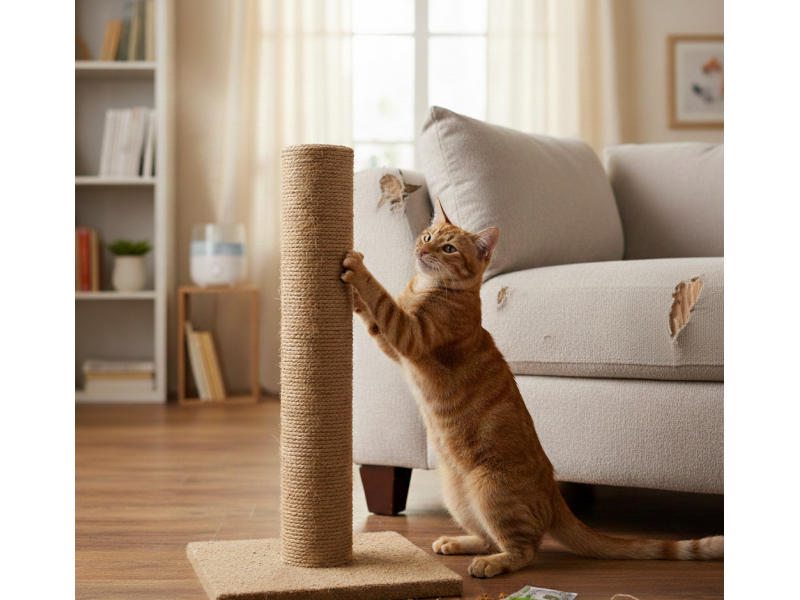
Anyone who has ever held a professional weeding tool in their hands or adjusted a sprayer knows: any spontaneous action in the household has its biological root cause. When owners ask why a domestic predator turns expensive furniture into straw, I always say - this is not pest control, but the natural vegetation of instincts. As practice shows, it is useless to fight this method of "herbicidal" pressure (shouts or punishment), a clear technological education map and quality service from Animal box are needed , which will help balance the ecosystem of your home.
From the experience of agronomists, we understand: if a plant lacks trace elements, it gets sick; if a cat lacks a special place to care for its weapons, it “cultivates” your sofa. In this article, we will analyze the psychology of the animal through the prism of practical management in order to forever close the issue of ragged corners and spoiled upholstery.
Biology question: why does a sofa become an "object of cultivation"?
In agronomy we study the morphology of plants, and in zoopsychology we study the morphology of behavior. When a cat scratches a sofa, it performs three critical operations at once. First, it is hygienic desiccation - the removal of dead parts of the claw. Second, it is marking the territory. In the pads of the paws there are glands that secrete pheromones. For a cat, your sofa is like a boundary post in a field, where it claims its property rights.
Thirdly, it is physical training. During scratching, the muscles of the back and shoulder girdle are involved. It is important to understand : if you simply forbid scratching, you will get "cultural stress", which will result in aggression or illness of the animal. We need not to forbid, but to redirect the vector of energy to another substrate.
Choosing a claw hammer: selection of materials and shapes
Just as we carefully choose the seed material, we must also be careful when choosing a scratching tool. There are a large number of "weeds" on the market - low-quality products that fall apart in a week. A true practicing agronomist looks at the density of the winding and the stability of the base.
Jute, cardboard or wood: what's better for the "scratch" season?
The quality of the material determines the service life. Jute rope is a classic, it reminds the cat of the bark of the tree to which it is accustomed in the wild. However, corrugated cardboard is often more attractive due to its softness and the characteristic sound when the fibers are torn. As practice shows , cardboard models are best suited for young individuals whose claws have not yet gained full strength.
Vertical and horizontal structures
The principle of tiering applies here. Some cats are “ground cultures” and like to scratch carpets. Others are “climbers” and mark vertical surfaces. To determine the type of your pet, look at how exactly he ruins the furniture. If he stretches out to his full height in a corner, you need a tall column. If he tears the seat, a horizontal panel.
Training technology: a step-by-step algorithm from a specialist
Training a cat to use a scratching post is like implementing a No-till system: it takes time, patience, and the right sequence of actions. You can't just put the device in a corner and wait for the result .
1. Location matters . Place the scratching post where your pet is already used to “working.” If it’s the corner of the sofa, place it right next to it. Gradually, 5–10 centimeters per day, you can move it to a place that’s convenient for you.
2. Attractants . Use "fertilizers" for interest - catnip or valerian in sprays. This stimulates the olfactory receptors and binds a positive association to the new object.
3. Praise and feed . Every time the cat shows interest in the right place, give out a “ration” in the form of a treat. According to the experience of agronomists , positive reinforcement works 300% more effectively than negative.
Crop protection: how to keep cats off furniture
While the transition period is ongoing, we need to protect the sofa. There are “repellents” for this. Cats can’t stand the smell of citrus fruits and sticky surfaces. Using double-sided tape on the corners of the sofa is the simplest mechanical barrier. The animal doesn’t like having its paws stuck to it and quickly loses interest in the object.
It is important to take into account the Ukrainian climate and conditions of detention.
It is worth remembering that in the conditions of central heating in Ukraine, the air in apartments becomes very dry in winter. This affects the condition of the stratum corneum of the animal's claws. They can become brittle, which provokes the cat to scratch the furniture more often and more vigorously. Monitor the humidity of the air and the quality of the diet so that the "harvest" of your pet's health is always at its best.
Conclusions and summary
Raising a cat is not a struggle, but resource management. By understanding the biological needs of the animal and providing it with a high-quality alternative to furniture, you maintain both peace in the house and the integrity of the interior. Remember: a systematic approach and patience are the key to success in any household . If you approach the matter with the mind of an agronomist, your sofa will remain intact, and the cat will be a satisfied predator. Do not postpone the "seeding" of education for later, start acting today!