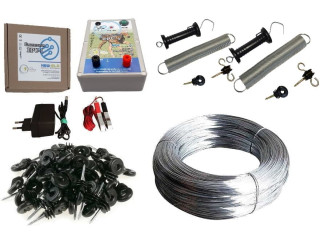
How to choose the right electric fence: key factors, power and types of systems
Choosing an electric fence is not just about choosing a generator or kit. The effectiveness of the system depends on the conditions of use, the type of animals, the length of the fence and even the condition of the soil. That is why when choosing an electric fence, it is important to consider not only the characteristics of the equipment, but also the real conditions of the farm.
What influences the choice of an electric fence
In practice, farmers most often encounter a situation where even a high-quality electric fence works poorly. The reason is the wrong selection for specific conditions.
- Type of animal — different coat, behavior and sensitivity to impulse
- Length of the fence — the larger the area, the greater the voltage loss
- Dry or wet soil — affects the quality of current flow
- Number of lines — 2–4 rows for different animals
- Seasonality — in winter, efficiency drops due to snow
It is the combination of these factors that determines which generator and kit will work stably and which will not.
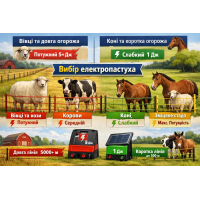
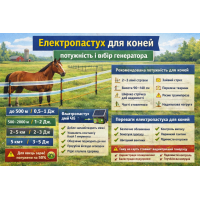
How many joules are needed for different animals
The power of an electric shepherd is measured in joules (J) and is a key parameter of the system. Insufficient power is one of the most common reasons for inefficient work.
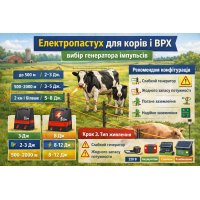
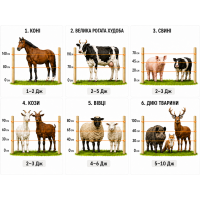
- Cows: 2–3 J - enough for short wool and stable behavior
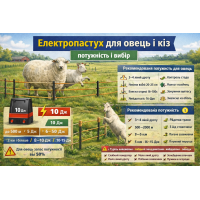
- Sheep: 4–6 J - thick wool significantly reduces conductivity
- Goats: 2–3 J - active, but respond well to impulse
- Wild animals: 5–10 J - need a power reserve due to endurance and aggression
It is important to understand: these values are relevant for normal conditions. If the soil is dry or the fence is long, you need a power reserve.
Why the difference occurs:
- Hair - insulates contact and reduces the strength of the impulse
- Behavior - wild animals ignore weak signals
- Contact resistance - dirt, dry skin and grass affect efficiency
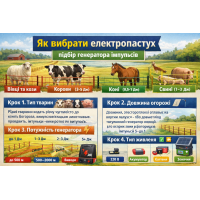
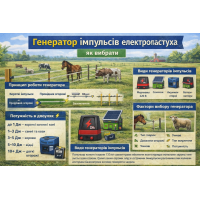
How to choose the right electric shepherd generator
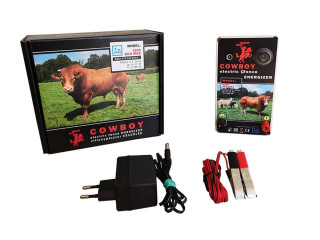
The generator is the basis of the entire system. It is he who determines whether the electric fence will work stably.
When choosing a generator, you need to consider:
- the actual length of the fence, not just the passport data
- the type of animals and their sensitivity
- soil conditions (dry, sandy, wet)
- the number of lines and the height of the fence
- the presence of vegetation that creates a current leak
In most cases, farmers make a mistake - they take the generator “straight up”. This leads to unstable operation. The right approach is to choose a model with a power reserve of at least 30–50%.
It is also important to choose the type of power supply:
- 220 V — for stationary systems near the farm
- 12 V — for mobile fences in the fields
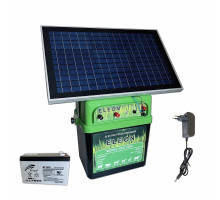
- solar — for autonomous operation without access to the network
Typical mistakes when choosing an electric fence
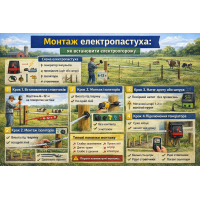
Most problems with electric fences arise not because of the equipment, but because of improper selection or installation.
- Weak generator — animals quickly stop responding to the impulse
- Poor grounding — the system loses up to 70% of efficiency
- Incorrect height lines — animals pass under or between the wire
- Ignoring soil conditions — especially critical for dry regions
- Lack of power reserve — the system does not work in winter
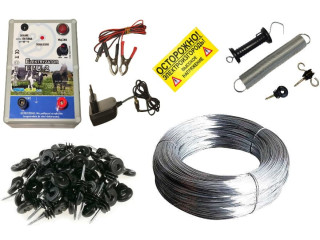
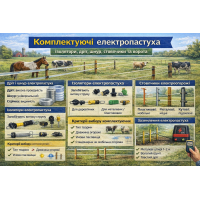
A high-quality electric fence is a complex: a generator, grounding, a correct line diagram and competent installation. This is what ensures stable operation of the system in any conditions.
FAQ - Questions and answers about electric shepherds
Which electric shepherd should I choose for cows?
Generators with a power of 2–3 J under standard conditions are best suited for cows. If the fence is long or the soil is dry, it is better to choose models with a reserve of 3–5 J. For large pastures or intensive use, it is recommended to take a generator with a reserve of power so that the system works stably in any weather.
Which electric shepherd is needed for sheep?
Sheep have thick wool that does not conduct current well, so they need generators with a power of 4–6 J. It is also important to use 3–4 fence lines and ensure high-quality grounding - without this, even a powerful electric shepherd will work poorly.
Can one electric shepherd be used for different animals?
Yes, but the most difficult conditions must be taken into account. If there are sheep and cows on the farm, you need to focus on sheep, that is, take a generator with a capacity of at least 4–6 J. Universal systems are always selected with a margin.
What to do if the electric shepherd is not working well?
The most common reasons are a weak generator, poor grounding or voltage loss due to grass, moisture or damage to the conductor. First of all, you need to check the grounding and contact connections, as well as clear the fence line of vegetation.
What grounding is needed for an electric shepherd?
High-quality grounding is the basis of the system. Usually, 1–3 metal pins with a length of 1 m are used, which are installed in moist soil. In dry conditions, the number of pins needs to be increased. Poor grounding can reduce the efficiency of an electric fence by 50–70%.
Which type of power supply is better: 220 V or 12 V?
If there is constant access to the power grid, it is better to choose 220 V models, they are more stable and do not require maintenance. For remote pastures, battery (12 V) or solar electric fences that operate autonomously are suitable.
Does an electric fence work in winter?
Yes, but efficiency may decrease due to snow, which does not conduct current well. In winter, it is recommended to use more powerful generators and pay special attention to grounding.
What is the correct height of the electric fence lines?
The height depends on the type of animals. For cows, 2 lines are usually used (approximately 40 and 90 cm), for sheep - 3-4 lines, for horses - 2 lines at a height of up to 140 cm. The wrong height leads to the fact that animals pass under or between the wires.
Is an electric shepherd safe for animals?
Yes, modern electric shepherds create short current pulses that do not harm the health of animals. They only form a conditioned reflex and prevent the fence from being violated.
What is better to buy: a ready-made kit or individual elements?
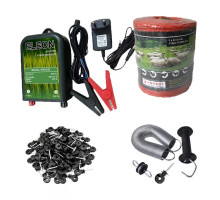
For most farms, it is more profitable to buy a ready-made electric shepherd kit - it is already selected for compatibility and power. It is advisable to buy individual components to modernize or expand an existing system.