Autumn sowing of winter wheat, barley and rapeseed requires farmers to take a balanced approach to soil nutrition. In order to form a strong root system and increase the frost resistance of plants, it is important to timely introduce the necessary macro- and microelements. When planning the budget for fertilizing, farmers take into account many factors, among which such a parameter as ammonium sulfate price, since sulfur and nitrogen in prolonged form are critically important for the initial development of winter crops.
The importance of autumn feeding for winter plants
The autumn period in the life of winter crops is decisive. It is at this time that the potential for the future harvest is laid, the tillering node is formed and the root system is built up. The lack of nutrients at the initial stages of development leads to the fact that plants enter the winter weak, accumulate insufficient sugars and become vulnerable to low temperatures and fungal diseases.
The main task of autumn fertilization is not to induce rapid vegetative growth, but to stimulate deep rooting and hardening of shoots. That is why the structure and proportions of fertilizers applied in autumn differ significantly from spring norms.
Basic nutrients for autumn application
For the full development of winter crops, a balanced complex of nutrients is necessary. Each element performs its specific function in the plant tissues.
Phosphorus and potassium are the foundation of winter hardiness
Phosphorus plays a key role in the formation of strong roots, accelerates seed germination and improves the absorption of moisture from deeper soil layers. Potassium is responsible for the regulation of water balance, the synthesis of carbohydrates and sugars, which act as a natural antifreeze in plant cells during frosts. The use of phosphorus-potassium fertilizers for the main tillage of the soil ensures the long-term availability of these elements throughout the autumn.
Nitrogen and sulfur - synergy for sugar accumulation
The use of nitrate nitrogen in the fall is undesirable, as it causes overgrowth of the vegetative mass. On the other hand, the ammonium form of nitrogen in combination with sulfur acts gently: it is bound by the soil complex, is not washed out by autumn rains and nourishes the plant gradually. Sulfur is a catalyst, without which nitrogen absorption is reduced by 30–40%, and also participates in the synthesis of essential amino acids.
Top effective solutions for applying in the fall
The agrochemical market offers a variety of fertilizer forms and formulations. Among the most effective and proven solutions for autumn treatment, the following classes can be distinguished:
1. Nitrogen-sulfur compounds (Ammonium sulfate)
This is one of the most effective solutions for autumn cultivation or pre-sowing preparation, especially for winter rapeseed and high-yielding wheat varieties. The fertilizer contains about 21% nitrogen in ammonium form ($NH_4^+$) and more than 24% readily available sulfate sulfur ($SO_4^{2-}$). Unlike nitrates, ammonium nitrogen is fixed in the upper soil layer and is not washed away by autumn precipitation into deeper horizons. This guarantees stable nutrition of the root system throughout the entire period until the onset of permanent frosts.
2. Complex NPK fertilizers with high phosphorus content
Formulas with low nitrogen and high concentrations of phosphorus and potassium are a classic choice for application under cultivation or directly at seeding. The granules dissolve slowly, providing plants with nutrition over a long period of time.
3. Ammophos and superphosphate
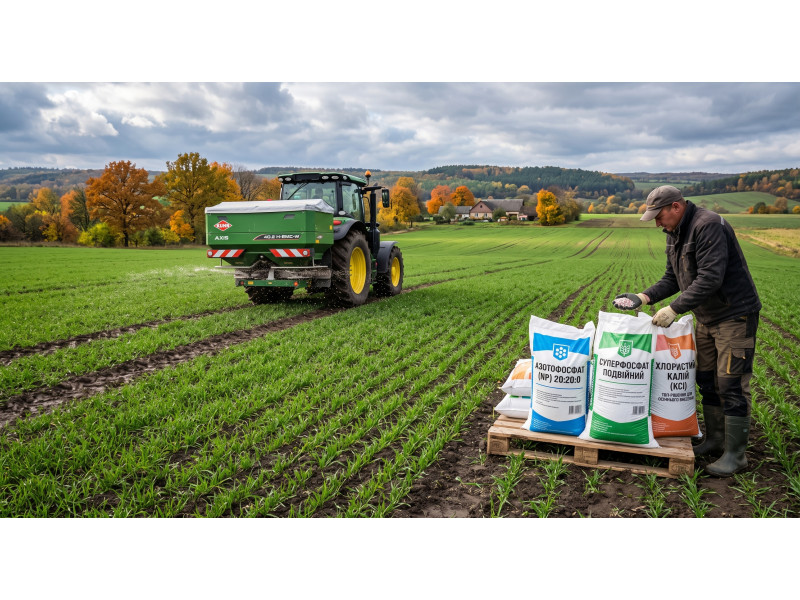
They serve as an excellent source of concentrated, available phosphorus. The application of ammophos provides a small amount of starter nitrogen, which stimulates the initial development of shoots and strengthens the embryonic root.
4. Potassium-magnesium mixtures
Applying potassium in the fall allows harmful impurities (e.g. chlorine) to be washed away by autumn rains, leaving only the beneficial element in the soil, which is necessary for the accumulation of sugars in the tillering node.
Practical tips for autumn application
In order for minerals to have the maximum effect, it is necessary to follow several practical rules:
- Wrapping depth. Phosphorus and sulfur elements are immobile or require contact with a moist layer. They should be incorporated to the depth of the main root mass (8–12 cm).
- Compensation for straw residues. If the predecessor was cereals with scattered straw, the application of ammonium sulfate makes it possible to compensate for nitrogen starvation that occurs during the decomposition of organic matter by soil bacteria.
- Balance according to soil analysis. Exact fertilizer application rates should be calculated based on laboratory analysis of the content of mobile elements in a specific field.
Successful wintering and future yield of winter crops are laid in the fall thanks to the correct choice and proportions of nutrients. A competently selected balance of phosphorus, potassium, nitrogen and sulfur guarantees a developed root system, frost resistance and resistance to stress. Purchasing high-quality mineral complexes for agricultural needs and getting professional advice will help Megachem online store, which offers a wide range of agrochemicals for any task.