Effective protection against pigeons: common mistakes and ways to avoid them
Pigeons, although they are common inhabitants of urban landscapes, can cause significant damage to private households, industrial buildings and agricultural facilities. Their droppings not only spoil the aesthetic appearance, but also destroy building materials, and can also be carriers of dangerous diseases. The choice and correct use of pigeon control products is key to achieving long-term results. Practical options on this topic are collected in the Pigeon Repellents category.
Often owners are faced with the ineffectiveness of the chosen methods, wasting time and money on solutions that do not give the desired effect. This may be due to a misunderstanding of bird behavior, errors in the installation of equipment or the choice of inappropriate means. Understanding these subtleties will avoid disappointment and ensure reliable protection of your facility.
Common mistakes when choosing and using equipment
Choosing the right tools to ensure effective pigeon repellers is a responsible task. The wrong approach can lead to a waste of resources and a lack of the expected result. Let's consider the most common mistakes made when operating such devices.
1. Insufficient assessment of the scale of the problem and selection of the wrong type of device
One of the most common mistakes is choosing a means without taking into account the specifics of the area and the number of birds. For example, using only visual methods in a large area where pigeons are already established may be ineffective. Birds quickly get used to static objects.
- Consequences: Pigeons ignore the repeller, continuing to cause damage.
- Prevention: Before purchasing, assess the area to be protected and the extent of the problem. For larger areas or when there are significant bird populations, consider combined methods or more powerful devices.
2. Improper placement and installation for bird protection
Even the most effective device will not work if it is not installed correctly. This applies to both physical placement and settings. For example, ultrasonic sensors can be ineffective if they are installed too low or if the sound waves are blocked by obstacles, which disrupts the quality of bird protection .
- Consequences: Decreased efficiency of the device, rapid habituation of birds.
- Prevention: Carefully study the manufacturer's instructions. Place the devices at the optimal height and at the correct angle. Make sure there are no obstacles to operation (for example, for ultrasonic or acoustic repellers).
3. Ignoring birds' habituation to certain methods
Pigeons are intelligent birds that are able to adapt. What works today may not work after a while. Birds can become accustomed to certain sounds, smells, or visual objects if they don't change.
- Consequences: The return of pigeons after initial success.
- Prevention: Change deterrent methods regularly, combine different types of devices. Use devices that mimic birds' natural enemies or create unpredictable stimuli.
4. Using only one type of pigeon control device
The best results are achieved through an integrated approach. Using only one type of equipment, for example, ultrasonic alone, may not be sufficient to completely evacuate the birds, so pigeon control must be systematic.
- Consequences: Incomplete solution to the problem, the need for constant monitoring.
- Prevention: Combine different methods. For example, install different types of devices: acoustic, ultrasonic, visual, and also use physical barriers (nets, spikes).
5. Neglecting safety for other animals and people
Some scaring methods can be dangerous to pets, wild birds, or even people. For example, sharp spikes or devices that make excessively loud sounds require caution.
- Consequences: Injuring pets, creating dangerous conditions.
- Prevention: Choose products that are safe for non-target species. Carefully study the characteristics of the devices and follow the manufacturer's recommendations for installation and operation.
6. Incorrect selection of devices for specific conditions
For example, using mains-powered devices in open areas without access to electricity, or conversely, using battery-powered devices in places with a constant power source, is inefficient.
- Consequences: Inability to use the device, additional power costs.
- Prevention: Before purchasing, determine the available power sources at the facility (electricity, solar power, batteries) and select devices accordingly.
Effective remedies for pigeons: an overview of options
There are many solutions on the market to solve this problem. It is important to choose the pigeon repellent that meets your needs and operating conditions.
Acoustic and ultrasonic repellers
These devices generate sounds that are unpleasant to birds. Acoustic repellers imitate the cries of birds of prey or sounds of danger, while ultrasonic repellers emit high-frequency waves that only animals can hear.
- Advantages: Can cover large areas, effective against various bird species.
- Disadvantages: Possibility of birds getting used to monotonous sounds, ineffectiveness in enclosed spaces for ultrasonic devices.
Visual deterrents and their role
This category includes shiny ribbons, 3D bird of prey figures, mirrors, and other objects that create movement or reflections. They are often used if birds on the roof become a real problem for homeowners.
- Advantages: Cheap, easy to use, no power required.
- Disadvantages: Least effective in the long term, birds quickly become accustomed to static objects.
Physical barriers
This category includes bird spikes, nets, and tensioned wires. They physically prevent pigeons from landing on certain surfaces, which is critical when birds on a balcony are damaging property.
- Advantages: Very effective, provides long-lasting protection, does not affect other animals.
- Disadvantages: Can be expensive to install, require certain skills for installation, can spoil the aesthetics of the building.
Bioacoustic bird repellers
These devices mimic the sounds of birds of prey or sounds that make birds feel threatened. When birds on a farm cause crop damage, such devices become indispensable helpers.
- Advantages: Effective, create realistic sounds that scare away birds.
- Disadvantages: Can be noticeable to people, requires a power source.
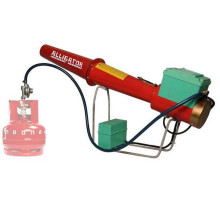
Propane repellers (guns)
These are powerful devices that create loud explosions, simulating gunshots. They are effective for protecting large areas from birds and wild animals.
- Advantages: Very high efficiency, covers large areas, can scare away not only birds, but also small animals.
- Disadvantages: Require compliance with safety regulations, can create significant noise, require regular maintenance and gas filling.
How to choose and buy repellers
When you decide to buy repellents , choosing the optimal product will depend on a number of factors:
- Object type: Balcony, house roof, industrial facility, farm field – each requires its own approach.
- Protection area: The power and range of the device depend on this.
- Budget: Prices for deterrents range from budget options to expensive automated systems.
- Availability of power source: Is there access to a power outlet or is a stand-alone device required?
- Desired level of intervention: Are you prepared to regularly maintain your devices or are you looking for a stand-alone solution?
Practical tips for operation and maintenance
Even the most advanced devices require proper care and proper use to ensure maximum efficiency.
- Regular inspection: Make sure devices are working properly, especially if they are battery or gas powered.
- Cleaning: Tools that have mechanical parts (such as propane guns) require periodic cleaning to remove dirt and dust.
- Update: If you use visual or acoustic methods, change their location or type periodically to prevent birds from becoming accustomed.
- Safety: Always follow the manufacturer's instructions when installing and operating appliances, especially those that use gas or make loud noises.
Frequently asked questions
Are ultrasonic repellers really effective against pigeons?
The effectiveness of ultrasonic repellers can vary. They work best against young birds that have not yet formed stable nesting sites. Adult pigeons can adapt to the sounds. They are often combined with other methods for best results.
How quickly do pigeons get used to repellents?
Pigeons can become accustomed to static or repetitive stimuli within days or weeks, so it is important to change tactics regularly: moving visual deterrents, changing sound signals, or combining different types of devices.
Are propane guns safe for people and pets?
Propane guns produce loud explosions that can be dangerous if used incorrectly or too close to residential areas. When used according to manufacturer's instructions and set up a safe distance from people and animals, they are relatively safe. However, it is important to note that they can be stressful for pets.
What type of repeller is best for a balcony?
For balconies, combined methods are often effective: installing bird spikes on railings, using shiny tapes or small acoustic repellers. It is important that these methods do not create inconvenience for residents and neighbors.
Are there environmentally friendly methods for controlling pigeons?
Yes, there are. Environmental methods include the use of natural repellents (e.g., certain plant extracts), visual deterrents (shiny objects, predator figures), physical barriers (nets, spikes). Also effective is the creation of conditions unfavorable for nesting (elimination of food and water sources, cleaning up garbage).

0 reviews / Write a review