Why can't goats and sheep be milked with a cow milking machine?
Machine milking of small ruminants has fundamental differences from the handling of cattle. The main reason lies in the animals' physiology and anatomy. A cow has four teats, whereas goats and sheep have only two. However, simply closing off two spare hoses on a cow milking system does not solve the problem and instead creates a risk to the animals' health.
Using unsuitable equipment can lead to serious udder injuries, the development of mastitis, teat canal hyperkeratosis and a sharp reduction in milk let-down. To maintain herd health and obtain quality milk, it is necessary to use specialised milking machines for goats and sheep. These systems are designed to account for the sensitivity of small animals' udders, operate at a different vacuum pressure level and have a significantly higher pulsation rate.
Key design differences between systems for small ruminants
To understand why a standard cow system is unsuitable for goats and sheep, it is worth examining the three main milking equipment assemblies in detail: the milking cluster, the teat liner and the operating settings of the vacuum unit.
Features of the milking cluster and collector
Cows are milked with heavy teat cups featuring metal shells and large collectors. The considerable weight of the milking cluster stimulates milk let-down in cows under the force of gravity. For goats and sheep, however, such weight is damaging. Heavy teat cups simply compress the delicate udder tissue, blocking the milk ducts.
A specialised complete milking cluster for sheep milking and goats is equipped with lightweight teat cups made from durable transparent plastic or silicone. The milk collector also plays an important role. For small ruminants, a compact 160 ml collector is used. This volume is optimal for quickly removing milk without creating excessive vacuum load on each udder quarter.
Teat liners: size and elasticity
The teat liner is the only part of the machine that comes into direct contact with the animal's body. Cow liners, such as DD.00-041A or 8-K type models, have a teat opening diameter that is too large and are too rigid. If used on a goat or sheep, they can cause a loss of airtightness (air leakage) or excessive compression of the teat.
Special models have been developed for small ruminants:
- Liner - 12S (for goats) — takes into account the elongated shape of the teat and the anatomical features of the goat's udder. It provides gentle compression and reliable fixation.
- Liner - 13S (for sheep) — adapted for the smaller teats of sheep, with a smaller internal diameter and increased elasticity to stimulate the rapid removal of fatty sheep's milk.
Using the correct teat liner geometry prevents injury to the teat sphincter and reduces the risk of pathogenic bacteria entering the mammary gland.
Working vacuum and pulsation rate
The physiology of milk secretion in small ruminants requires a faster stimulation rhythm. Let us compare the operating parameters of the systems:
- For cows: vacuum pressure is 47–50 kPa, and the pulsation rate is 50–60 cycles per minute.
- For goats: vacuum pressure is reduced to 38–42 kPa, while the pulsation rate is increased to 90–110 cycles per minute.
- For sheep: due to the characteristics of milk let-down and the high viscosity of the fat, the operating pressure is maintained at 40–44 kPa, while the rate is increased to 110–130 cycles per minute.
Rapid pulsation imitates the natural suckling of a lamb or kid, activating the release of the hormone oxytocin, which is responsible for milk let-down. The active phase of oxytocin's action in goats and sheep is very short — only 3–4 minutes — so the milking process must be as fast and intensive as possible.
Comparative analysis: milking goats or milking sheep?
Although goats and sheep are both small ruminants, their milking requirements differ. These features should be taken into account when selecting equipment configuration.
- Udder anatomy: In goats, teats are usually larger and point downwards or slightly forwards. In sheep, teats are smaller and are often positioned at an angle or almost horizontally on the sides of the udder. Therefore, a sheep milking cluster requires more grippy and elastic silicone liners to prevent the teat cups from falling off.
- Milk structure: Sheep's milk is considerably fattier and contains more dry matter. It cools more quickly and can clog narrow outlet fittings. Therefore, sheep systems require careful monitoring of collector flow-through and regular rinsing with hot water.
- Animal behaviour: Sheep are more timid animals. Sudden noises or vacuum hissing can completely block the milk let-down reflex. It is critically important to select quiet oil pumps for them or place the vacuum unit in another room. Goats become accustomed to noise more quickly, but they are particular about cleanliness and comfort during the procedure.
How to choose the right equipment: a step-by-step guide
For successful milking automation on a smallholding or professional farm, it is recommended to follow this selection process:
Step 1: Determine the herd size
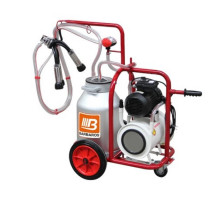
For a small household farm of up to 10–15 animals, the optimal choice is a mobile milking machine on a trolley with one bucket. For medium-sized farms with 20–50 animals, it is better to purchase a unit designed for the simultaneous connection of two milking clusters. If the herd exceeds 100 animals, it is advisable to consider a stationary installation, such as the SDU-1 stationary milking unit, with a dedicated milking area (platform) and milk pipeline.
Step 2: Choose the type of vacuum pump
Dry pumps are easier to maintain and start readily in cold weather, but they operate rather noisily. Oil pumps operate almost silently, making them ideal for timid goats and sheep. However, they require constant monitoring of the lubricant level and regular oil changes.
Step 3: Choose the material of the teat liners and teat cups
Silicone components are more durable, hygienic and gentler on the udder. They do not lose their elasticity in freezing conditions and can last for up to 1–2 years without replacement. Rubber liners are cheaper, but need to be replaced every 6 months because microcracks form in them and accumulate bacteria.
Common mistakes when selecting and operating equipment
Even high-quality equipment can operate inefficiently if common mistakes are made during use:
- Exceeding the vacuum level. Trying to speed up milking by raising the pressure above 45 kPa injures the delicate teat tissue, causes pain to the animal and encourages the development of subclinical mastitis.
- Ignoring consumable wear. Old, stretched teat liners lose their ability to massage the teat properly. This causes milk to stagnate in the upper udder quarters and gradually reduces overall milk yield.
- Insufficient hygiene. Poorly washed hoses and collectors become a source of bacterial contamination in the milk. Using dirty equipment quickly leads to mastitis throughout the herd.
Recommendations for servicing and caring for the machine
To ensure that the equipment lasts a long time and milk quality remains high, follow this daily care routine:
- Immediately after milking: Rinse the system with clean warm water at 35–40°C to remove milk residues. Do not use hot water at the first stage, as the protein will coagulate and bake onto the hose walls.
- Circulation cleaning: Run a hot solution at 60–65°C of a specialised cleaning agent through the system. Alternate alkaline agents for removing fat with acidic agents to prevent the formation of milkstone.
- Rinsing and drying: Rinse the system with clean cold water and hang the milking cluster so that all residual moisture drains away completely.
Check the condition of the pulsator regularly. Dirt or moisture entering the pulsator disrupts its operating rhythm, which negatively affects the animals' behaviour during milking.
Frequently asked questions from customers (FAQ)
Can one machine be used for milking both goats and sheep?
Yes, the vacuum unit itself (pump and receiver) can be shared. However, the milking clusters, teat liners and pulsator settings should be specific to each animal species because of differences in anatomy and the physiology of milk let-down.
How often should goat teat liners be replaced?
Rubber liners should be replaced every 6 months or after 750 milking cycles. Silicone liners are more wear-resistant and can last for up to 12–18 months (or up to 1,500 milking cycles) with proper care.
What collector volume is optimal for small ruminants?
A 160 ml collector is best suited to goats and sheep. It ensures rapid milk removal without creating extra weight that could injure the animal's delicate udder.
Why do the teat cups fall off while the machine is operating?
The main causes are an excessively low working vacuum level, worn teat liners (which lose their elasticity and airtightness), or a liner size that is unsuitable for the animal's teat size.

0 reviews / Write a review