Effective pigeon repellers: overview and selection for your site
Pigeons, despite their peaceful nature, can be a real problem for farmers, homeowners, and city dwellers. They not only pollute the territory with their droppings, but can also carry diseases, damage crops, harvests, and building elements. Effective pigeon repellers help solve this problem by offering different approaches to controlling the number of birds.
Choosing the right device depends on many factors, including the size of the area, sensitivity to noise, available budget and specific needs. In this article, we will look at the different types of repellers available in our catalog, compare their effectiveness, applications and help you make an informed choice.
A variety of bird repellers: from noise to light
Today, the market offers a wide range of bird deterrents, each with its own characteristics. It is important to understand the principles of their operation in order to choose the optimal solution for a particular situation. Our range includes various categories, such as PRODUCTS FOR LIVESTOCK , which also includes effective bird control products.
Propane repellers: powerful protection for large areas
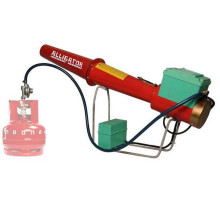
Propane bird repellers, also known as gas guns, are one of the most powerful and effective means of protecting large agricultural lands, orchards, vineyards and other open areas. Their principle of operation is based on the periodic creation of a loud sound that simulates a gunshot or explosion, effectively scaring away pigeons and other birds.
- How it works: The device uses a propane (or butane) cylinder that is fed into the combustion chamber. An electronic or mechanical igniter creates a spark, which causes the gas-air mixture to explode and make a loud popping sound.
- Application: Ideal for protecting fields where crops, fruits, berries are grown, as well as for large farms. Models like the KBS-U1 Electronic Remote Control Propane Bird and Animal Repellent (available with ranges of 200 m, 500 m, 2000 m) provide significant coverage.
- Advantages: High efficiency on large areas, the ability to adjust the intervals between shots, some models have remote control or automatic on/off. The catalog presents the models KBS-U1, KBS-E1, KBS-E2, KBS-E3, as well as GUARDIAN-2.
- Limitations: Loud sound can be a problem for residential areas, require regular replacement of gas cylinders, require maintenance (e.g. replacement of reducer, membrane, piezo).
Sound and bioacoustic repellers: adaptive pigeon repeller
Sound bird repellers use specially designed sound signals to create discomfort and scare pigeons away. Bioacoustic models, in particular, imitate the cries of birds of prey or the alarm cries of pigeons themselves, which causes them to instinctively fear.
- Principle of operation: The devices play programmed sounds through speakers. These can be the sounds of predators (hawks, falcons), cries of distress of birds, or other noises unpleasant for pigeons.
- Applications: Suitable for gardens, small farms, warehouses, as well as for protecting balconies and roofs in urban areas where the use of loud propane guns is inappropriate. Examples include the Korshun 16 Sound Bird Scarer (15 ha, 4 speakers) and the Korshun 8 Sound Bird Scarer (10 ha, 2 speakers), as well as the Sapsan 3 Sound Bird Scarer with 220V/12V power supply.
- Advantages: Less invasive than propane guns, ability to adjust volume and types of sounds, coverage of large areas (up to 15 hectares).
- Limitations: Birds can become accustomed to constant sounds, so it is important to periodically change the sequence or type of sounds. Effectiveness may be reduced in conditions of strong background noise.
Visual deterrents: a simple but effective solution
Visual bird deterrents use visual stimuli to create the illusion of danger or an obstacle to deter pigeons. These can be 3D models of birds of prey, shiny ribbons, mirrors, or other elements that move in the wind.
- How it works: Birds react to objects they perceive as a threat or unusual phenomenon. Moving or shiny elements create the effect of the presence of a predator or danger.
- Application: Effective for small areas, gardens, vegetable gardens, balconies, window openings, as well as for protecting small buildings. The Crow bird repeller set with a flagpole is a prime example of such a solution.
- Advantages: Low cost, do not require electricity, environmentally friendly, easy to install.
- Limitations: Birds quickly become accustomed to static visual deterrents, so they need to be moved periodically or combined with other methods. Effectiveness depends on weather conditions (wind for movable elements).
Ultrasonic repellers: silent protection
Ultrasonic bird repellers generate high-frequency sound waves that are inaudible to humans but cause discomfort to birds. Although our catalog does not present specific products in this category, the presence of the subcategory "Ultrasonic Bird Repellents" indicates their relevance on the market.
- Principle of operation: Emitting ultrasound, which affects the hearing system of birds, creating an unpleasant environment for them.
- Application: Can be used in places where noise is unacceptable - balconies, small yards, warehouses, closed rooms.
- Advantages: Silent for humans, invisible, can work continuously.
- Limitations: The effectiveness of ultrasound for scaring birds is often debated, as ultrasound waves do not penetrate obstacles (walls, leaves) well and may not be as effective on pigeons as they are on rodents. The range is usually limited.
Laser repellers: an innovative approach
Laser bird repellers use moving laser beams to simulate a physical threat or movement that scares birds away. Like ultrasonic, this category is present in our catalog ("Laser Bird Repellents"), indicating their presence on the market, although specific models are not listed among the products.
- Principle of operation: A bright laser beam moving along a certain trajectory is perceived by birds as a physical danger or a large object approaching, forcing them to fly away.
- Application: Effective for large spaces (hangars, warehouses) or open areas in twilight/darkness.
- Advantages: High efficiency, especially in low light conditions, noiselessness, possibility of automation.
- Limitations: High cost, effectiveness decreases in bright sunlight, may require special permission or compliance with safety regulations (do not point at people, aircraft).
It is also worth mentioning universal animal repellers, such as the GREENMILL GR5108 battery-powered animal repeller with a regulator, which can be effective against pigeons in small areas, combining different methods of influence.
How to choose the best pigeon repeller: key criteria
Choosing the most effective pigeon repellent requires taking several important factors into account. There is no one-size-fits-all solution, so it is important to analyze your needs.
Area and type of plot
- For large fields and agricultural complexes: Propane guns, such as the KBS-U1, KBS-E1, KBS-E2, KBS-E3, GUARDIAN-2 series, are the best choice due to their ability to cover large areas (up to 2000 m) and high efficiency.
- For medium-sized areas (gardens, small farms up to 15 hectares): Sound repellers like Korshun 16 or Korshun 8, Sapsan 3 will provide sufficient coverage without excessive noise for neighbors.
- For small areas (balconies, roofs, vegetable gardens): Visual repellers (e.g., Crow Bird Repellent Kit with Flagpole), ultrasonic devices, or universal animal repellers (GREENMILL GR5108) will be most appropriate.
Noise level and environmental impact
This is a critical factor, especially if your site is near residential buildings or public areas.
- Loud: Propane guns produce very loud sounds that can be unbearable for people and pets in the immediate vicinity. Their use is often limited to remote agricultural areas.
- Moderate noise level: Acoustic and bioacoustic repellers produce audible sounds, but their volume is usually adjustable. You can choose models that are effective for birds but not too disruptive to humans.
- Silent: Ultrasonic and laser repellers are completely silent to humans, making them ideal for use in urban environments or indoors.
Power type and autonomy
- Autonomous: Propane guns operate from gas cylinders, providing high autonomy. Some sound repellers and the GREENMILL GR5108 can operate from batteries.
- Mains powered: Many sound repellers, including the Sapsan 3, can be connected to a 220V or 12V network, which ensures uninterrupted operation, but requires access to a power source.
- Passive: Visual deterrents do not require any power supply.
Budget and operating costs
- High cost: Laser and some propane repellers can have a significant initial cost. In addition, propane guns require regular gas costs and possible replacement of parts (diaphragm, piezo, reducer).
- Average cost: Sound repellers are a compromise between price and effectiveness. Operating costs are related to electricity.
- Low cost: Visual deterrents are the most affordable in terms of initial investment and have no operating costs.
Weather resistance and durability
Devices designed for outdoor use must be resistant to rain, snow, wind, and temperature extremes. Most propane and sonic repellers are made to withstand harsh conditions. Visual repellers tend to be less durable and may require periodic replacement.
Mistakes when choosing and using pigeon repellers
Even the most advanced repellent can be ineffective if it is not chosen or used correctly. Here are some common mistakes:
- Underestimating the area: Choosing a device with insufficient range for your area. Always check the recommended coverage area for models like the Kite 16 or KBS-U1.
- Ignoring Habituation: Birds, especially pigeons, are intelligent and can become habituated to the same type of stimuli over and over again. It is important to change the placement of visual deterrents, modify the sound signals, or the intervals of shots in propane guns.
- Incorrect placement: Placing the repeller behind obstacles (trees, buildings) that block the propagation of sound or light.
- Neglecting Maintenance: Propane guns require periodic inspection and replacement of worn parts, such as diaphragms or reducers. Failure to maintain them can lead to reduced efficiency or failure.
- Choosing a device that is too loud for a residential area: Propane guns are not suitable for urban environments due to the intense noise.
Additional products for effective pigeon control
For the most effective control of pigeons and other birds, as well as to ensure the smooth operation of the repellers, additional accessories and spare parts may be required. Our catalog includes:
- Spare parts for gas bird scarers: These include propane gun reducers (e.g. GUARDIAN-2, KBS-M1, KBS-M1S, KBS-M2), diaphragms (GUARDIAN, KBS-M1), piezos (GUARDIAN, KBS-E1, KBS-M1) and electronic control boards (Kurtsan KBS E1). Having these components will extend the life of your propane scarer.
- Power supplies: Batteries for stand-alone models, such as the GREENMILL GR5108 Animal Repellent.
- Additional visual elements: Although not all are presented as separate pigeon products, understanding the category "Visual Bird Deterrents" suggests the presence of such products.
Frequently asked questions about pigeon repellers
Do ultrasonic repellers work on pigeons?
The effectiveness of ultrasonic pigeon repellers is a matter of debate. While they may be effective against some rodents and insects, their effectiveness against birds, especially pigeons, is often limited. Ultrasound does not penetrate obstacles well and is not effective in open spaces or large areas. They are best considered as a supplement to other methods or for very small, enclosed areas.
How often should I change the locations of the repellers?
To prevent birds from becoming accustomed to the repellers, it is recommended to periodically change their location or mode of operation. For visual repellers, this can be every few days or a week. For sound and propane repellers, it is advisable to change the intervals and sequence of sounds/shots, or move the device every 1-2 weeks, if possible. This helps maintain the effect of surprise and fear.
Are propane guns safe for pets?
Propane guns produce a very loud sound that can be frightening and stressful to pets, especially dogs and horses, if they are in the vicinity. Although they do not cause physical harm, the constant loud noise is undesirable. It is recommended that they be used well away from pets or during periods when pets are not on the property. Always follow the manufacturer's instructions for safe operation.
Which repeller is best for a small garden near the house?
For a small garden near the house, visual repellers (such as the Crow Bird Repellent Kit with Flagpole) that do not make noise are best. You can also consider sound repellers with adjustable volume that reproduce the cries of birds of prey, or the universal GREENMILL GR5108 Animal Repellent. Propane guns are usually too loud for such conditions.
Is there an effective pigeon repeller that works 24/7 without intervention?
Most modern repellers are designed to operate autonomously. Propane guns with electronic control (e.g. KBS-U1) can operate 24/7 if connected to a gas cylinder and have a sufficient supply of fuel. Sound repellers (Korshun, Sapsan) can also operate continuously if connected to a power source. To prevent habituation, it is desirable that these devices have a function of randomizing the intervals or types of signals. Visual repellers work passively, but their effectiveness must be periodically updated by moving them.
See also in the catalog
Read also

0 reviews / Write a review