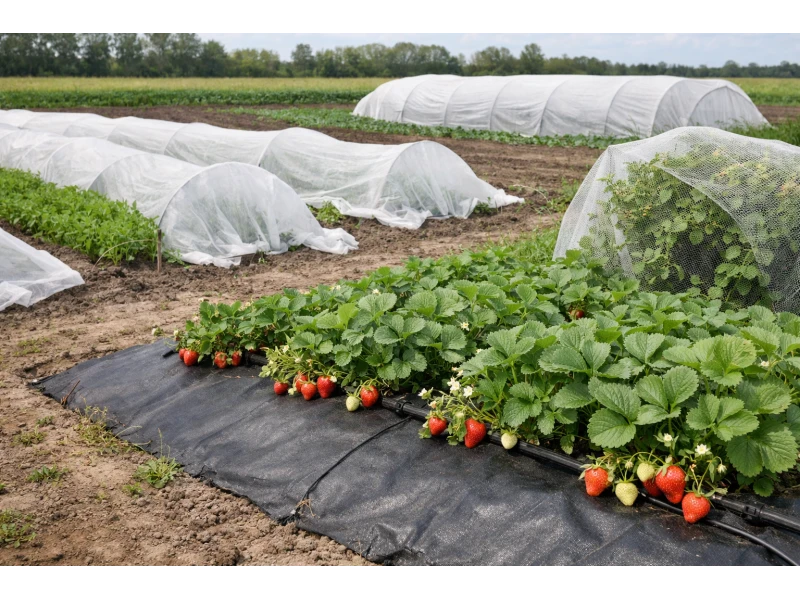
Agrofibre has long ceased to be a "summer cottage" thing. In farms, it works as an inexpensive tool that shifts the harvest 1–3 weeks earlier, protects crops from frost and pests, and reduces weeding costs. We analyze how it is used in practice and how not to make a mistake with the choice.
Four problems that agrofiber solves
|
Problem |
What canvas? |
How to use |
|---|---|---|
|
Early harvest of vegetables |
White 17–30 g/m² |
Cover crops of carrots, radishes, cabbage directly on the ground or on arcs |
|
Frost protection |
White 30–50 g/m² |
Low tunnels over seedlings and strawberries |
|
Mulch against weeds |
Black 50–60 g/m² |
Spread out on the bed and plant the plants in the slots |
|
Protection from birds and insects |
White 17–23 g/m² |
Cover berry bushes and cruciferous crops |
Early vegetables: a gain in time
Under the white canvas, the soil warms up faster, and during the day the temperature is maintained more evenly without overheating. In practice, this gives earlier shoots and earlier access to the market, when prices are still high. It is important to monitor the temperature: on warm days, the canvas on the arcs is opened from the ends.
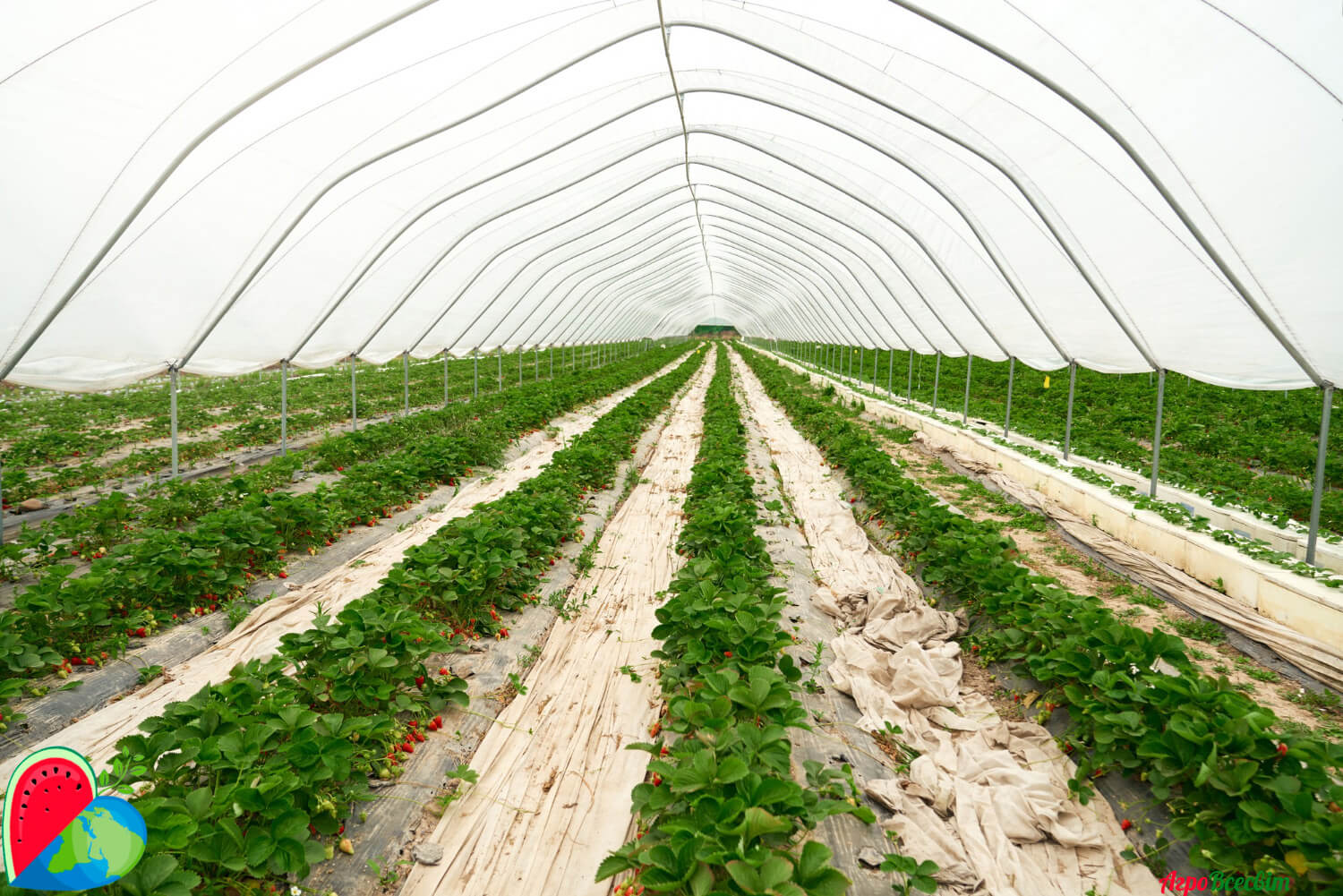
Rows of strawberries in a tunnel greenhouse on a mulching sheet.
Strawberries on black agrofibre
For berry growers, black agrofibre with a density of 50–60 g/m² solves several problems at once: weeds do not germinate, berries do not lie on the ground and rot less, the soil retains moisture longer. A drip tape is usually placed under the canvas. More details about the technique can be found in the article about mulching.
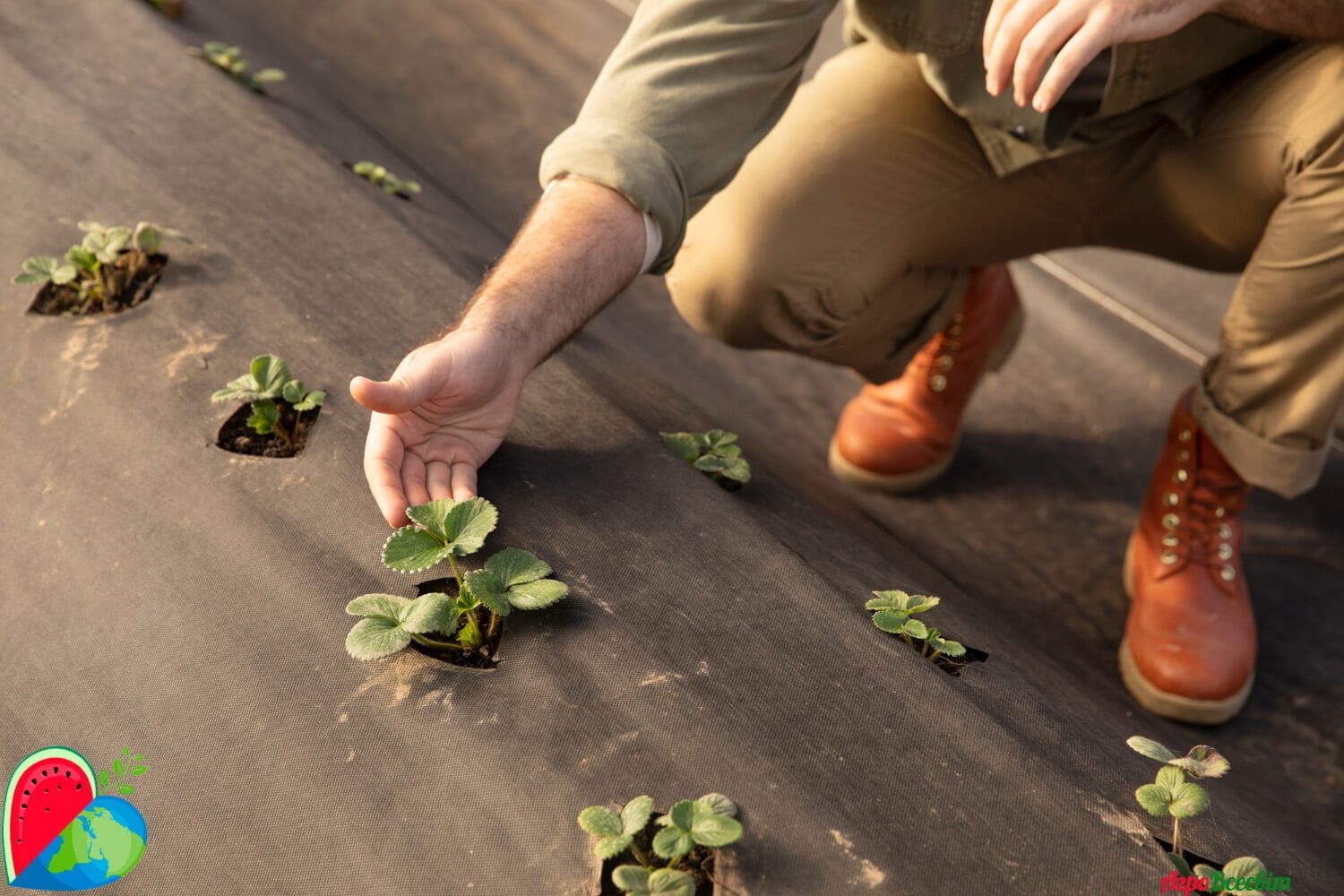
Seedlings are planted in cross-shaped slits in the canvas.
The procedure is simple: prepare and level the ridge, lay a drip line, spread the canvas, secure the edges with pegs every 50–100 cm, make slits and plant the seedlings. The width of the canvas is selected according to the width of the ridge plus 20–30 cm for each edge.
Protection from birds and insects
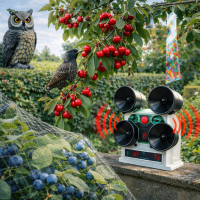
A lightweight 17–23 g/m² canvas, placed directly on the crops, prevents cruciferous fleas and cabbage flies from reaching the plants, and birds from reaching the berries. Unlike netting, it also slightly raises the temperature, which is only a plus for early crops.
How to calculate the need for a field
- Determine the length of the rows or ridges and the number of ridges.
- For mulch: ridge length + 0.5 m for securing the edges.
- For tunnels: ridge width + 2 arc heights + 0.5 m.
- Count the pegs: 2 for every linear meter along the edges for mulch, 1 per meter for the tunnel.
For large areas, it is more profitable to take rolls 3.2 m wide or more and 100–250 m long, and for small areas, canvas per meter.
Tunnels in the field: how to equip
For low tunnels, arches made of 5–6 mm metal rods or fiberglass are used, installed every 1–1.5 m. A height of 40–60 cm provides enough air above the plants, and the tunnel itself is easy to maintain from both sides. A 3.2 m wide canvas covers a 1–1.2 m ridge with arches. The edges are pressed down with soil or secured with pegs, and on top, in windy fields, twine is additionally stretched in a “snake” pattern between the arches — then the canvas does not sail.
Ventilate the tunnels by opening the ends or lifting one side of the canvas on warm days. For strawberries, the shelter is usually removed during flowering to allow pollinators access to the flowers, and returned if nighttime temperatures are predicted to drop below zero.
How to extend the life of the canvas
- After the season, dry the canvas and shake off the soil.
- Store rolled up in a dark, dry place, away from rodents.
- Do not drag the canvas over stubble and sharp stakes - most often it tears when you remove it.
- Label the rolls by density: white 17 and 30 g/m² are easy to confuse.
White or black: short
White cloth lets light through — it is used to cover plants. Black cloth does not let light through — it is placed on the soil under plants as mulch. There is also a two-tone black and white cloth: the black side down against weeds, the white side up, so that the soil and berries do not overheat in the summer.
Frequently asked questions
Black agrofibre or mulch film?
The film is cheaper, but it does not let water and air through and is more often disposable. Agrofiber lets in precipitation, lasts for several seasons, and the soil under it overheats less.
Is a UV stabilizer needed?
Yes. Without it, the canvas will break down in the sun in one season. High-quality agrofiber contains a stabilizer.
Where to get canvas for the farm?
White and black agrofibre of different densities, in rolls and by the meter, as well as pegs for fastening, can be picked up at agrovsesvit.com.
Agrofiber is one of the few tools that pays for itself in the first season: earlier harvest, less frost damage, and less manual weeding.