A free plot near a garden or field does not mean that it is enough to simply place a few hives there and wait for the honey harvest. An apiary quickly becomes a separate production area with its own routes, equipment, supplies, seasonal work and storage requirements. If the farm is already engaged in crop production or livestock farming, the new direction will have to be incorporated into the existing infrastructure so that bees, machinery, workers and animals do not interfere with each other.
That is why it is worth starting not with the number of hives, but with the farm scheme. It is necessary to assess the location of the future apiary, access to water, roads for transporting equipment, the availability of space for frames and containers, the surrounding honey base and the ability to safely carry out seasonal work. Basic equipment can be compared in advance on a specialized platform, but the final set will depend on the format of a particular apiary.
This is especially important for a farm. There are already field work schedules, warehouses, transport, workshops, livestock premises and areas of constant human movement. The apiary should become part of this system, and not create another site that will have to be constantly bypassed or redone.
You need to start with the location, not with the equipment
Even an expensive hive will not compensate for the unsuccessful location of the apiary. Before installing it, you need to look at the site from the perspective of daily operation: how to get to it, where the bees will go after departure, whether there is a constant passage of people, a walking area for animals or a route for agricultural machinery nearby.
Hives should not be placed directly near the gate, loading area, cowshed, a place where livestock are regularly watered, or a road along which a tractor moves during the day. Even if at first such a point seems convenient due to its proximity to the warehouse, during active flight it can create unnecessary problems.
On the other hand, an apiary that is too far away complicates the work. Frames, enclosures, feeders, tools and other materials will have to be carried or brought. During honey extraction, the number of such movements increases dramatically.
A practical location must meet several conditions:
- the hives can be reached by transport or a farm cart;
- there is no constant intensive movement of people and animals nearby;
- the site does not turn into a stagnantly wet place after rain;
- there is an opportunity to organize water for the bees;
- the hives can be inspected and maintained without the difficult task of carrying inventory;
- there is a sufficient feed base nearby during the season;
- the apiary does not interfere with the main production processes of the farm.
The honey base determines the logic of the season
It makes sense to plan the number of bee colonies together with the honey base. The presence of a large field nearby does not in itself mean a continuous season. One crop can give a short period of active flowering, after which a completely different situation begins for the bees.
For a farm, it is useful to draw up a simple calendar of plant flowering in the radius of the apiary's work. It includes gardens, field crops, meadows, forest belts, perennial herbs and specially sown honey plants. Such a calendar will not give an accurate forecast of honey collection, but will show potential breaks between the main flowering waves.
This is especially important for mixed farms, where part of the land is used for animal feed crops. Some fields can simultaneously be part of the enterprise's feed system and affect the working conditions of the apiary. However, agronomic decisions here should be made primarily based on the technology of growing the crop, and not only on the interests of the apiary.
It is also necessary to take into account plant treatment. The beekeeper must know the schedule of field work and coordinate it in advance with the agronomist or owner of neighboring lands. For a farm where crop production and beekeeping are carried out by the same team, it is easier to organize this through a common seasonal calendar.
What equipment is needed at the start
The set of equipment depends on the scale. For several hives, it makes no sense to immediately purchase equipment designed for a large commercial apiary. But even saving on basic things creates unnecessary manual work and problems in the first season.
The starter kit can be conditionally divided into four groups.
Hives and components
You need the hives themselves, frames, honeycomb, feeders, dividers and other elements according to the chosen design. On a farm, it is especially convenient when most of the apiary is standardized. The uniform format of frames and housings simplifies maintenance and reduces the inventory of various components.
Tools for working with bees
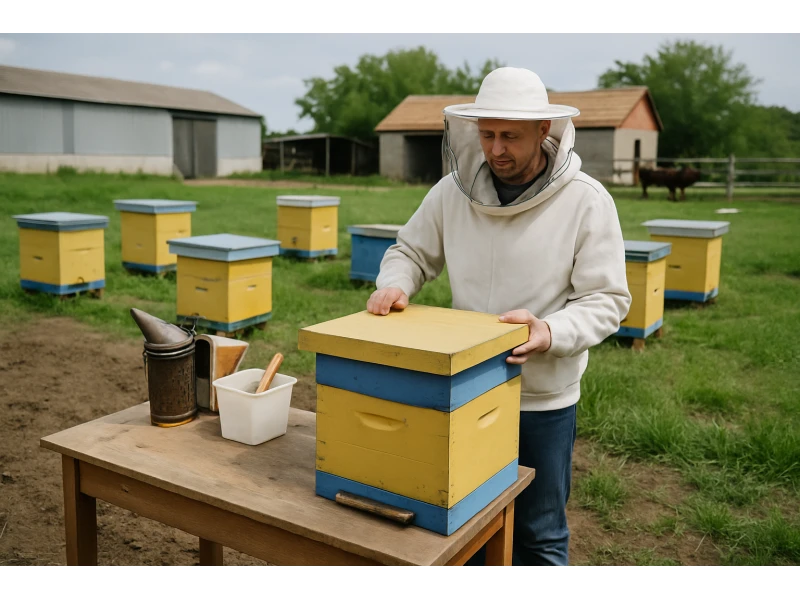
The basic set includes a beekeeping chisel, chimney, brush, box or tool bag. It is better to store the inventory separately from general household tools so that during an urgent inspection you do not have to look for it in the workshop.
Protective clothing
A suit, jacket or overalls with a mask are needed not only by the apiary owner. If other farm workers are sometimes involved in the work, it is worth having a spare set of the appropriate size.
Equipment for working with honey
A honey extractor, containers, sieve, tables or devices for unsealing frames are needed already at the stage of receiving marketable products. Their scale should be selected according to the number of frames that will actually have to be processed during the working day.
Apiary and livestock farm: how to divide work flows
In a mixed farm, a separate question arises: how to combine beekeeping with keeping cattle, sheep, goats, poultry or other animals. The main principle is simple - do not create permanent crossing points.
Beehives should not be located where animals regularly go to pasture or water. You should also not use the apiary fence as part of the pen. Animals can accidentally damage the hives, stands or other equipment.
Water is organized separately. Drinking bowls for livestock and bee drinkers perform different functions. If you do not provide a convenient source of water near the apiary, the bees may start using other available places on the farm, which is not always convenient for the workers.
It is also important to separate storage areas. It is better not to keep frames, honeycomb, honey containers and beekeeping equipment together with feed, veterinary products, fuel, lubricants or chemicals.
Comparison of apiary formats for a farm
The optimal model depends not only on the budget. The number of workers, available time, honey base and whether the honey is planned to be sold are also important. A small auxiliary direction and a commercial apiary require different organization.
| Format | Main goal | Equipment requirements | Load during the season | Premises requirements | Main limitation | Who is suitable for |
|---|---|---|---|---|---|---|
| Several hives | Learn the technology and get a small amount of products | Basic set | Moderate | Small area for inventory | Equipment is used irregularly | Private farm or novice farmer |
| Small farm apiary | Additional direction of the farm | Standardized hives and basic pumping equipment | Seasonal peaks of work | A separate dry place for frames and containers is required | Work may coincide with the field season | Mixed farming |
| Apiary near the garden | Beekeeping in parallel with gardening | Depends on the number of families | Spring is especially important | It is desirable to have a place near the garden | Coordination of agricultural work is required | For gardening farms |
| Nomadic apiary | Working with multiple honey harvests | Additional equipment for moving | High during transportation | Requires a storage base between trips | Logistics and preparation for transportation | For farms with transport capabilities |
| Commodity stationary apiary | Regular sales of products | Complete set for processing a significant number of frames | High during peak periods | Requires a separate area for working with honey | Requires stable sales of products | For farms where beekeeping becomes a separate business line |
Practical conclusion: It is better to increase the size of the apiary after the farm understands the actual load during the full season. Adding new hives is easier than rebuilding the warehouse, changing the route of equipment or urgently looking for equipment for pumping out a large number of frames.
It is better to plan the honey room in advance
While the apiary consists of several hives, working with honey seems to be an episodic operation. When the volume increases, it quickly becomes clear that a separate clean place is needed for frames, unsealing, honey extractors, settling and containers.
It is not always convenient to use the first free room on the farm for this. A feed warehouse, workshop, garage or room with veterinary supplies have a different purpose. Honey needs an area where it can be kept clean and free of foreign odors.
Even before the first significant pumping, it is worth determining:
- where the frames will be temporarily located;
- where the honey extractor will be located;
- how to move full and empty frames;
- where to store clean containers;
- where to transfer honey after pumping;
- how to wash and dry equipment;
- where the finished product will be stored.
A well-organized route should be short and clear: the frames arrive at the work area, are unsealed and pumped, after which the honey enters the prepared containers. The fewer chaotic movements, the easier it is to maintain order.
What happens during the first season
It is useful to perceive the first season not as a test of maximum productivity, but as a collection of your own data. It is then that it becomes clear how convenient the location of the hives is, how long the inspections take, where delays occur, and how apiary work fits into the main production calendar.
Spring launch
The condition of the colonies, feed supplies, hives, and inventory are checked. At the same time, the farm assesses whether the routes of the equipment or animals have changed after the winter.
Period of active development
The frequency of work with frames and housings increases. It is here that it becomes noticeable whether there are enough spare components and how conveniently they are stored.
Main honey collection
It is necessary to simultaneously monitor the condition of the colonies and prepare the area for working with honey. If this period coincides with active field work, it is better to distribute responsibilities between workers in advance.
Pumping
In practice, it is this stage that most often reveals the weaknesses of the infrastructure. Insufficient containers, inconvenient location of the honey extractor or lack of space for frames slow down the work more than it seems when planning.
Preparation for the next season
After completing the main work, it is worth writing down what had to be urgently purchased, what equipment was idle and where unnecessary movements occurred. These records are much more useful for scaling than the general impression of the season.
When the apiary transitions from a commercial to a commodity format
The appearance of a surplus of honey does not mean that the farm is ready for systematic sales. The commodity direction begins when it is possible to stably divide batches, store the product, package it and explain to the buyer the origin of a particular honey.
For retail sales, packaging, convenience of packaging, clear names of varieties and consistency of the assortment are important. You can see how such products can be presented to the end buyer, for example, on the apiary's website. This is useful even before scaling up: the farmer sees that the production process does not end after pumping.
If the farm plans to sell large batches, the logic is different. Here, mass, uniformity, packaging, storage, sampling, and logistics come to the fore. Therefore, it is better to determine the sales channel before purchasing packaging equipment.
Control calendar for the first year
To prevent the apiary from existing separately from the rest of the farm, it is advisable to include its work in the general production calendar.
| Stage or period | Farm activities | What needs to be controlled | Typical risk | Success criterion |
|---|---|---|---|---|
| Before installing the hives | Select a site and outline work routes | Movement of equipment, people and animals | The apiary is on an active path | Workflows do not intersect |
| Equipment preparation | Unify hives, frames and basic inventory | Compatibility of components | Excess of different formats | Main elements are interchangeable |
| Beginning of the season | Check families and site condition | Need for repairs and supplies | Urgent purchases during active work | Basic stock prepared |
| Active flowering | Compare apiary and field work | Schedule of work in the fields | Lack of coordination between departments | Employees know the common calendar |
| Before honey collection | Prepare the honey extractor, containers and premises | Cleanliness and readiness of the equipment | Lack of containers at the right time | The working area is ready to receive frames |
| Pumping | Organize the sequential movement of frames and honey | Simple and unnecessary transfers | Overloading of a small working area | The process takes place without chaotic movements |
| Storage | Separate batches and label the containers | Origin and condition of the product | Mixing different honey collections | Each batch has clear labeling |
| After the season | Estimate time and equipment costs | Bottlenecks in the process | Scaling without analyzing the first year | There is a list of specific changes for the next season |
Scaling the apiary together with the infrastructure
For a private farm, a few hives can remain a small additional direction for years. For a farm with land, transport and employees, the potential for scaling is greater, but that is why it is especially easy to increase the number of families faster than production capacity.
Before expanding, it is worth checking not only the space for new hives. Practical questions need to be answered: who will serve the additional families, will there be enough frames and buildings, how will the load change during pumping, where will the finished honey be stored and through which channel will it be sold?
The apiary develops most sustainably when each new stage is provided with infrastructure. First, the farm works out the basic technology, then eliminates weaknesses, standardizes inventory, and only then increases the volume. In such a scheme, beekeeping truly becomes part of the farm, and not a separate seasonal project that has to be reorganized every year.