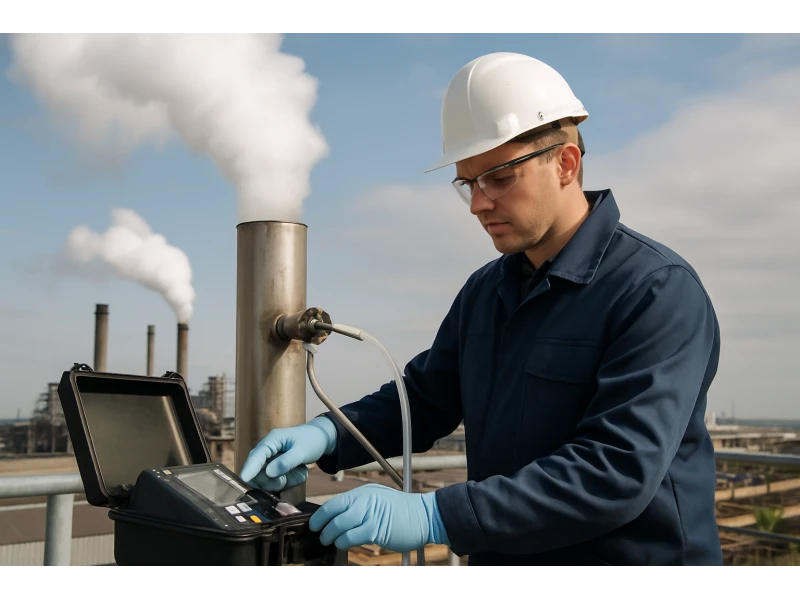
Industrial emissions are formed during fuel combustion, drying, painting, raw material processing, operation of boilers, furnaces, ventilation systems and many other technological processes. The actual composition of the gas-dust flow depends not only on the type of equipment, but also on the load, quality of fuel, raw material, condition of filters and operating mode. That is why it is important for the enterprise to rely on measurements, and not only on calculated assumptions.
Before leaving the laboratory, it is worth preparing a list of sources, a brief description of the technology, data on fuel or raw material, operating mode and cleaning system. The list of controlled substances may differ for each source. A boiler room, paint booth, dryer and metalworking area require different control programs. More information about pollutant emission analysis can be found on the profile service page.
The representativeness of the selection is of fundamental importance. The equipment should operate in a typical mode, and the measurement point should allow obtaining a sample that characterizes the flow. It is advisable for the enterprise to ensure safe access to the gas duct or pipe and the presence of a responsible technical person in advance.
It is useful to compare the results in dynamics. After repairing the filter, replacing the burner, changing the raw material or upgrading the technology, repeated control shows whether the measure really affected the indicators. Thus, laboratory data becomes not a formality, but a tool for environmental and technical management.
For large enterprises, it is advisable to keep a history of measurements for each source. This allows you to see atypical changes, identify problem areas more quickly and plan environmental investments. The more stable the methodology and conditions of comparison, the more valuable such a history is. Comprehensive studies are performed by an accredited environmental research laboratory, which presents the main areas of laboratory control.
When ordering work, it is important to formulate the goal: planned production control, assessment after modernization, verification of the purification system, preparation of initial data or another task. The list of indicators, the number of measurements and the organization of sampling depend on the goal.
Practical recommendations
Before ordering a study, it is worth clearly defining what decision should be made based on the results. For the topic "pollutant emission analysis" this is especially important: the goal affects the list of indicators, selection rules, number of samples and method of data interpretation. It is advisable for the customer to provide the laboratory with information about the origin of the sample, operating or production conditions and known risk factors. If the study is repeated, it is advisable to maintain the same basic program so that the results of different periods can be correctly compared. In the case of an atypical result, one should not rush to conclusions: sometimes a re-sampling, control of related indicators or checking another point is required. This approach turns laboratory analysis from a one-time procedure into a practical tool for quality control, technology and environmental risks.
Conclusion
A professional approach to the topic of "pollutant emission analysis" begins with a correctly formulated task and a representative sample. Laboratory results are most useful when they meet the specific purpose of the customer and can be compared with the conditions in which the sample was taken. That is why it is worth agreeing on the program with specialists before the study, and after receiving the results, evaluating them in the context of a specific object.
What to pay attention to when choosing a laboratory
Not only deadlines and price are important for the customer. It is worth clarifying whether the laboratory meets the required indicators, what requirements are set for the sample, whether professional sampling is possible and in what form the results are provided. If the data is required for official procedures, it is necessary to separately agree on the requirements for the documents and check whether the specific study falls within the competence of the laboratory. Such a check before starting work helps to avoid repeated analysis and to obtain a document suitable for the intended purpose.