After each season, grain remains in warehouses that traders do not want to buy at full price. The reasons are well known to farmers: part of the crop was damaged by insects, humidity failed somewhere, and individual batches did not pass the quality or other indicators. Such grain is sold at a significant discount or lies in the warehouse for years. The paradox is that in parallel, farms spend money on the purchase of feed. It is at this junction between unsold grain and the need for feeding that the opportunity for additional earnings is often hidden.
Why substandard grain has become a problem for many farms
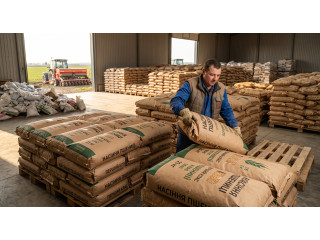
After cleaning and sorting, some of the grain loses its market value, although it remains suitable for feed use. Buyers reduce the price due to damage, moisture deviations or other quality indicators. As a result, the farm actually sells part of the crop much cheaper than its potential value.
| Grain condition | Estimated market value |
| Food grain | 100% of market price |
| Feed grain | 20–40% cheaper |
| Unfit grain | 40–70% cheaper |
| Cleaning waste | often almost never implemented |
The greatest losses occur precisely when the grain still contains nutritional value, but is no longer of interest to the market as a commodity product.
Why feeding animals regular grain is not always profitable
It is usually not possible to sell substandard grain at a good price, so they keep it for their own farm. It seems like a logical solution: the grain is already there, and therefore the feed is practically ready. But after several months of feeding, the question often arises why grain consumption remains high, and the result does not always meet expectations. The reason is simple. Ordinary grain, even after grinding, does not fully give its nutritional value. Some of the energy and nutrients are used less efficiently than they could. This difference becomes especially noticeable where feed is counted in tons every day, and any excess consumption directly affects the cost of meat, milk or eggs.
How the extruder changes the value of grain
During extrusion, the grain undergoes short-term processing under high pressure and temperature, which can reach 130–150°C. The process lasts a few seconds, but the grain structure changes significantly. Starches are converted into a more digestible form. Unwanted microflora is partially destroyed. Feed digestibility improves. That is why network extruders are increasingly used not only on large farms, but also in small farms with their own feed base. From a technological point of view, grain does not become a different product. It simply starts to work more efficiently.
Why farmers use extruders not only for high-quality grain
The situation is one on small farms, completely different on large ones. But the logic is the same. If the equipment is already working, not only high-quality grain is passed through it, but also less liquid raw materials after sorting and processing.
The following are most often processed through an extruder:
- corn;
- wheat;
- barley;
- soy;
- grain mixtures;
- part of substandard grain after cleaning.
In this way, the farm obtains a feed product from raw materials that would bring much less income if sold.
Why not just the screw is important when choosing an extruder
The search for an extruder usually begins with the characteristics. They compare performance, engine power, and electricity consumption. But when it comes to buying, the range of questions becomes much wider. It is important for the farm not only to find the right model, but also to understand whether it is suitable for specific volumes of work and types of raw materials.
In practice, it is at the selection stage that most mistakes occur. Equipment that is too productive is not used to its full capacity, and equipment that is too weak quickly becomes a bottleneck in feed production. Therefore, farmers are increasingly looking not just for a seller of equipment, but for a company that will help them understand the nuances and choose equipment for the real needs of the farm.
One such supplier on the Ukrainian market is TMS Agro. The company works with extruders of various capacities, from models for small farms to solutions for larger farms, and also advises on the choice of equipment depending on the tasks of the farm.
Not every grain can be sold profitably. But almost every grain can be put to profitable use.
The market evaluates grain according to one criteria, the farm according to another. What may be a non-conformity for a trader often remains a valuable resource for livestock farming. That is why the struggle for profitability today increasingly begins not with finding a more expensive buyer, but with finding a more efficient way to use your own harvest.