Why Cattle Need a Specialised Electric Fence
Organising grazing for cattle requires reliable control of the territory. Traditional wooden or metal fences require significant financial expenditure and installation time. Modern LIVESTOCK PRODUCTS offer a much more flexible and economical solution — electric fences. If you are planning to optimise the grazing process, it is worth determining in advance which electric fence for cows to buy so that the system operates reliably in all weather conditions.
Cows have unique physiological characteristics that must be taken into account when choosing equipment. Due to their thick skin, dense coat and considerable body weight, they are less sensitive to weak electrical pulses than, for example, pigs or smaller animals. Therefore, a standard low-power energiser may prove ineffective. The animals simply will not feel sufficient resistance and will quickly destroy the line. Specialised electric fence kits for cows are developed with these factors in mind, providing an optimum electric shock strength that is completely safe for the health of the livestock but creates a lasting conditioned reflex to avoid approaching the pasture boundary.
Key Criteria for Choosing a Kit for Cows
When choosing an electric fence for cattle, you should not buy the first option you find. You need to analyse the operating conditions, terrain, perimeter length and biological characteristics of your herd in detail.
Energiser Power (Pulse Energy)
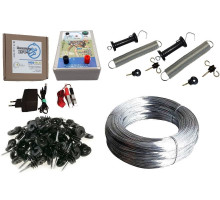
The energiser is the heart of the entire system. It converts direct or alternating current into short, high-voltage pulses. For keeping cows, the output pulse energy should be at least 1–2 joules for small pastures. If the territory is large and dense grass or shrubs grow along the line, touching the wire and causing current leakage, a more powerful device is required. For example, an option such as Powerful Electric Fence for Wild Animals and Sheep EPU 5J/10J DUO 230V demonstrates high efficiency in difficult areas with heavy vegetation, as it has a significant power reserve for overcoming resistance.
Power Source: Mains, Battery or Solar Panel
- Mains-powered energisers (220V). An ideal option if the pasture is located close to a farm or residential buildings. They provide stable operation without the need to constantly monitor the battery charge.
- Battery-powered energisers (12V). Mobile devices powered by car batteries or special deep-cycle batteries. They are indispensable for remote pastures whose location is changed frequently.
- Combined (DUO) systems. These can operate from either a 220V mains supply or a 12V battery. This provides maximum versatility and uninterrupted system operation in the event of a power cut.
Choosing Conductors: Rope, Wire or Tape
Conductors transmit the electrical pulse around the entire perimeter of the pasture. Several types of conductors are used for cattle:
- Rope or cord. This is one of the most popular options thanks to its optimum balance of strength, conductivity and price. Quality electric fence rope cord, such as ELEON 3-Strand Electric Fence Rope (Cord), contains stainless steel or copper metal conductors, ensuring stable current transmission over long distances without a significant voltage drop.
- Tape. This is wider (for example, 20 mm or more), making it clearly visible to animals. The use of tapes such as Farmer Yellow Horse Tape 20 mm, 200 m or white equivalents is recommended in areas where animals need to see the pasture boundary from a distance, to avoid accidental high-speed collisions.
- Galvanised steel wire. A reliable and durable option for permanent fences, although it is more difficult to install and dismantle when the pasture is moved frequently.
Components Without Which the System Will Not Work Effectively
The reliability of an electric fence depends not only on the power of the energiser but also on small installation details. Poor-quality connections or insulators can undermine the operation of even the most expensive energiser.
Insulators and Fasteners
Electric current must flow exclusively through the conductor. If the cord touches a wooden post, metal reinforcement bar or damp ground, current leakage occurs and the voltage on the line drops. Special insulators are used to prevent this:
- For wooden supports, use an Electric Fence Insulator with Self-Tapping Screw, which can be easily screwed into the wood using a special screwdriver attachment.
- For metal post systems, use an Electric Fence Insulator for Metal Posts from 8 to 14 mm (with Screw).
- If you use fibreglass reinforcement, special fixings such as Electric Fence Fixing for 10 mm Fibreglass Reinforcement (100 pcs/pack) or similar 6 mm and 12 mm options are indispensable. They securely hold the conductor at the required height and prevent it from slipping.
Correctly Connecting Conductors
It is strictly forbidden to tie cords or tapes using ordinary knots. Knots create high resistance, produce sparks, burn the thin metal strands inside the cord and lead to a complete loss of voltage on the line. To connect broken sections or extend the length, you must use a special Wire and Cord Connector or Electric Fence Tape Connector. These provide a tight metal contact and maintain the conductivity of the system.
Monitoring Operation: Voltage Testers and Indicators
An electric fence operates continuously under the influence of external factors such as wind, rain, dew, wild animals and vegetation. To detect a voltage drop or a broken line in good time, a farmer needs a specialised tool. Using improvised means or checking for current by touch is dangerous and inhumane.
A professional electric fence voltage tester is used for regular monitoring. For example, the Horizont 6-Level Electric Fence Voltage Tester (Poland), 2–10 kV allows you to quickly measure the exact voltage level on the line and locate the point of current leakage. If the voltage has fallen below 3,000 V, this indicates that there is a short circuit to earth somewhere, caused by grass or a damaged insulator. For continuous visual monitoring, you can also install an ELEON Electric Fence Indicator for Electric Fences, which flashes with every pulse, signalling that the system is working even from a distance.
How to Calculate the Height and Number of Lines for Cows
For effective containment of cows, a two-line or three-line conductor layout is usually sufficient. The hanging height depends on the animals’ age and breed:
- For adult herds (cows and bulls): install 2 conductor lines. The lower line is fitted approximately 50–60 cm above the ground, while the upper line is installed at a height of 90–110 cm. This prevents animals from lowering their heads to dig under the fence or jumping over it.
- For mixed herds (cows with calves): a three-line system is recommended. Position the lines at heights of 40–45 cm, 75–80 cm and 105–110 cm. The low first line is essential because small calves can easily pass under a high wire and get lost.
It is important to monitor the tension of the cord. Insufficient tension causes sagging, lines to short against one another or rapid breakage caused by wind or the animals themselves.
Training the Herd to Use an Electric Fence: Practical Steps
You should not simply release the animals into a large new pasture immediately after installing the electric fence. They must go through an adaptation period:
- Create a small training pen near the farm where the electric fence line will be clearly visible. Use bright tape or tie marker tape to the cord.
- Bring the animals to the fence one at a time or in small groups. One or two contacts with the wire are usually enough for a cow to understand the connection between touching it and receiving an unpleasant pulse.
- Only after the animals begin to show a clear reluctance to approach the fence should they be moved to the main pasture.
Common Mistakes When Buying and Installing an Electric Fence
Many farm owners experience system problems because of simple mistakes during the planning and installation stages:
- Poor earthing. This is the most common mistake (up to 80% of all complaints about a weak shock). The electrical pulse returns to the energiser through the ground when an animal touches the wire. If the earth rods are installed incorrectly, are too short or are driven into dry sand, the circuit will not be completed and the cow will not feel the shock at all. You should use at least three metal rods at least 1 metre long, driven into damp soil.
- Using an energiser that is too weak. Trying to save money by buying a device with pulse energy below 0.5 J for a large pasture will result in the cows simply ignoring the fence.
- Neglecting to clear grass from the area. If tall grass or shrub branches are constantly touching the conductor, the pulse will continuously flow into the ground. The energiser will quickly drain the battery, and the voltage at the end of the line will fall to a critical level.
- Twisting conductors into knots. As already mentioned, this damages conductivity. Use only purpose-made metal connectors.
When an Electric Fence Is Not Suitable: Alternatives and Limitations
An electric fence is primarily a psychological barrier, not a physical wall. An animal avoids the wire because it is afraid of receiving an unpleasant electric shock. However, there are situations in which using an electric fence is ineffective or undesirable:
- Near high-speed roads. If the pasture borders a busy road, using only an electric fence is risky. If frightened, the herd could break through the fence and run onto the road. A strong physical fence is required here, supplemented by an electric fence on the inside.
- For aggressive breeding bulls during periods of activity. When aroused, an animal may ignore the electric shock and break the system. Such animals require strong metal or wooden pens.
- On extremely dry, sandy or rocky soils. As dry sand and rocks have very low electrical conductivity, earthing will work poorly. In such cases, it is necessary to build a two-wire system in which one wire is connected to the positive pole of the energiser and the other to earth, so that the animal receives a shock when touching both wires simultaneously.
FAQ (Frequently Asked Questions from Buyers)
Is an electric fence safe for cows and people?
Yes, it is completely safe. The energiser produces high-voltage pulses, but they are extremely short in duration (microseconds) and have low current strength. Such a shock causes a strong unpleasant sensation and muscle contraction but does not cause burns or endanger the lives of animals or people.
What length of fence can one energiser support?
This depends on the power of the device and the condition of the pasture. Manufacturers specify the maximum length for ideal conditions, with no grass. For real conditions with average weed growth, divide the stated length by 3 or 4. For large areas, choose energisers with pulse energy of 3–5 J or more.
What should I do if the cows tear the electric fence cord?
First, check for voltage using a tester. The most common cause of breaks is a lack of current on the line, caused by a discharged battery, poor earthing or a short circuit through the grass. Animals quickly realise that the wire has stopped “biting” and begin to tear it. Also make sure that you are using clearly visible conductors.
Can ordinary metal reinforcement bars be used as posts?
Yes, they can. However, metal posts require the mandatory use of quality insulators that prevent current from flowing into the ground through the metal. Special screw-in insulators or universal fittings for reinforcement bars are ideal for this purpose.

0 reviews / Write a review