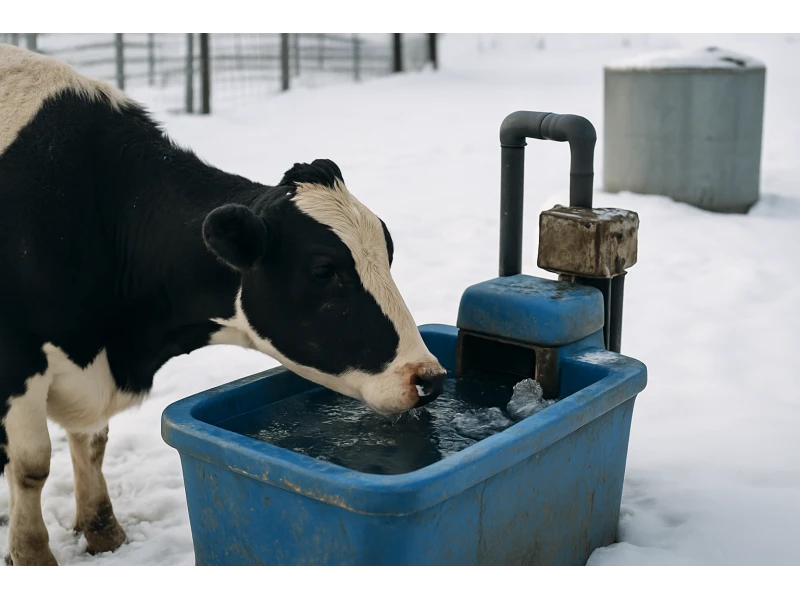
A cow that drinks ice water in winter is not getting enough feed. The energy to warm up what it drinks is taken from the diet, and if the waterer freezes for even a few hours, the animal reduces its dry matter intake, and milk production drops at the next milking.
Watering livestock in winter depends on three things: how much water the livestock needs, what temperature it is, and what it is stored in. The last part is the most common failure. The farm's water tank, pipes, and valves that have been left unattended in the summer, are turned into a source of downtime by the first frost, because water expands when it freezes and tears apart anything that doesn't have a reserve for that volume.
How much water do animals need in the cold season?
In winter, animals drink less than in the heat, but the difference is not as great as it seems. A lactating beef cow, which drinks about 60 liters on a hot day, consumes about 42 liters in December at +4 °C. For dairy herds, the main guideline is different: for every kilogram of milk, a cow needs 4-5 liters of water, and this proportion does not depend on the season.
Below are daily intakes for the main animal species according to zootechnical reference books for temperate climates. The figures are in liters and rounded. Actual intake depends on the diet, feed moisture and productivity, so the table shows an order of magnitude, not an exact plan.
Group of animals | Conditions | Water, l per day |
|---|---|---|
Milch cow | about 23 kg of milk per day | 87-102 |
Dry cow | launch period | 34-49 |
Beef cow with calf | winter, about +4 °C | about 42 |
Calf | 1-4 months | 5-13 |
Ewe | lactation period | 8-11 |
Sow | lactation period | 19-30 |
Horse | without working load, +20 °C | about 31 |
Snow is no substitute for drinking.
An animal will not eat enough snow or ice to cover its daily needs, and melting it in its stomach uses the same energy from the feed that it could have converted into growth or milk. Therefore, liquid water in winter must be available constantly, not on a schedule.
What temperature of water is needed for drinking?
For cattle in the cold season, water with a temperature of 14-16 °C is recommended. This is a compromise between physiology and technology. Warmer water is difficult to keep in the open air, and colder water is less likely to be consumed by cows and they drink less.
Too cold water affects productivity from two sides. One-time consumption drops, and the animal does not get its daily norm. Body temperature drops, and the body compensates for heat loss from the diet, so the same feed yields less production. In calves and young animals, the consequence is more noticeable: colds become more frequent, especially when cold water coincides with drafts in the room.
Cows drink quickly and in large portions, in a few minutes a day in total. Hence the requirement for the supply: at least 10 liters of water must flow into the drinking bowl per minute. A weak supply means that the animal leaves without drinking, and the next one in line waits until the bowl is filled.
How many watering places are needed?
The number of drinkers is calculated based on the number of animals, not the area of the premises. For a group of 200 animals, the device should serve 8 animals at the same time, and in cowsheds with box housing, no more than 20 cows should be per drinker.
When there are fewer places, the problem is exacerbated in winter. Weaker animals are squeezed out of water at the very time when they are already reluctant to drink it, and the difference in productivity within the group increases.
Automatic waterers with heating and frost protection
A non-freezing waterer works on one of three principles. The most common option is with an electric heater: a heating element in a bowl or in a housing keeps the water above zero and is turned on by a thermostat. A continuous flow valve does not require heating: the water flows constantly, does not stagnate and does not have time to freeze. A geothermal waterer takes heat from the ground through a pipe buried below the freezing zone and consumes the least electricity, but requires excavation.
For open drinking bowls and containers, immersion heaters and heating cable are used, which are wrapped around internal pipes and nozzles. The cable is designed for the entire section from the inlet to the bowl. The coldest place always freezes, most often the vertical riser near the door or gate.
The water supply to the drinking bowls freezes more often than the bowls themselves. No amount of heating the bowl will save a pipe that goes to the run on the surface or shallowly. The main is laid below the depth of soil freezing for your region, and the outlet to the surface is insulated and heated with a cable.
A separate issue is power outages. A waterer with a heater without power freezes just like a regular one, and during a long cold night the ice manages to break the valve body. On farms where power outages are long, they put a backup power supply on the water heating line or keep a buffer tank in a warm room, from which the livestock can be watered manually.
Water tank on the farm: material, volume and placement
A buffer tank is needed when the well or water supply cannot keep up with peak consumption during morning watering after milking, and in case the pump is without electricity.
The volume is calculated from the daily requirement of the livestock plus a reserve for the time the pump is idle. A herd of 50 dairy cows with a milk yield of about 23 kg according to the table above drinks approximately 5 thousand liters per day, so a 1000 liter container covers only a few hours. For such a herd, the reserve is placed in several cubes or one large container is taken.
For drinking water, containers made of food-grade polyethylene (PE, HDPE), stainless steel or fiberglass with a food-grade coating are suitable. Polyethylene is lightweight, does not rust and does not react with water, so plastic water containers are the most common on farms. The main condition: the container must have a document confirming its approval for contact with food products, otherwise substances that do not belong there may pass from the plastic into the water.
Color matters. A light translucent container lets in light in the sun, and the water in it blooms with algae already in the warm season. For drinking water, dark opaque containers are used or placed indoors. Ultraviolet light also ages polyethylene itself: over the years, the wall becomes brittle, and in the cold, the fragile plastic cracks from a slight impact.
The shape of the tank also affects winter operation. A vertical cylindrical tank takes up less space and is easier to insulate, while a horizontal tank is easier to place under a canopy and service through the top hatch. In any case, a tightly closing lid and a breathing hole with a mesh are required: without it, the tank pulls the walls inward during water withdrawal, and the open neck collects dust, bird droppings, and debris from the roof.
The container is placed on a flat base without sharp protrusions. A full ton of water presses on the bottom, and a stone or piece of reinforcement under it pushes through the wall in a few seasons. A container that is outside is insulated for the winter, moved to a warm room, or completely drained along with the tap.
Eurocube under water: when is it suitable and when is it not
A Eurocube, or IBC container, consists of a 1000-liter high-density polyethylene flask and a steel crate. It is readily accepted for water on the farm. The cube is cheaper than a special tank, is stackable, has a ready-made crane at the bottom and a standard base of 1200 by 1000 mm, which is easy to place on a pallet or concrete platform.
Only a new container with a food certificate or a container that has previously transported food products is suitable for watering livestock. A container from agrochemicals, lubricants, or technical fluids is not suitable for drinking water. Polyethylene absorbs some of the substance into the wall thickness, washing does not completely remove it, and the residues gradually pass into the water.
In the cold, the Eurocube has two vulnerable spots. The DN50 tap at the bottom freezes first: the water in the tap body stands still, the ice breaks it or the bulb pipe to which the tap is screwed cracks. The corners of the bulb suffer from ice expansion, because the wall there works by bending.
A cube that winters outside is either drained completely with the tap open, or insulated with the crate and an immersion heater placed in the flask. Insulation without a heater only delays freezing for a few days, so in frosty weather, water from such a cube is taken daily, preventing it from stagnating.
A cracked bulb does not always need to be replaced. If the polyethylene has retained its elasticity and the crack does not pass through the tap thread, it is welded with a rod of the same material. A detailed analysis of what How to repair a cracked euro cube, shows where such a repair holds, and where it is easier to replace the bulb.
Why do plastic containers crack in winter?
When water freezes, it increases in volume by approximately 9%.
Ice forms first on the top and walls, and the liquid inside is trapped. When it also freezes, the pressure expands the container from the inside, and the plastic tears at the weakest point: near the fittings, in the corners, along the weld line. Therefore, a container that cannot be drained is not filled to the brim, leaving room for the ice to expand.
Fragility is affected by the age of the container. Polyethylene is flexible at sub-zero temperatures, but after several seasons in the sun its impact strength drops. A blow with a bucket, a hoof, or a piece of ice trying to knock it out of the container produces a crack that would not have occurred in the summer.
The most damaging is defrosting with an open flame or blowtorch. Polyethylene overheats locally, loses its shape, and a network of microcracks appears around the heated area. The frozen container is warmed gradually, in a warm room or with warm air from a distance.
A crack in a polyethylene container is not glued. The surface energy of this material is so low that no household or universal glue forms a strong bond with it and the layer peels off after the first cycle of freezing and thawing. A reliable repair is provided by welding with the same polymer, with the development of the crack and drilling its ends so that it does not go further. Technically, this process and what determines the strength of the seam are described in the material about how to weld cracks in plastic tanks.
Water cleanliness and tank care
The quality of water for livestock is assessed primarily by total mineralization. Water with a dissolved salt content of up to 500 mg/l is considered normal, health and productivity problems begin when the indicator exceeds 3000 mg/l. Water from a well is tested in a laboratory at least once a year, and after a flood or well repair, especially after the turn.
Drinkers and containers are cleaned regularly. Food and saliva accumulate in the bowls, and a biofilm forms on the walls of the tanks. In winter, cleaning is postponed due to the cold, although it is then that stagnant water in insulated containers becomes a breeding ground for bacteria. After washing, the container is rinsed with clean water so that no product residues get into the drinker.
After winter, the containers are inspected separately.
A thin crack near the fitting is not visible when the tank is full; it appears as a wet spot on the base or a slow drop in level. Such damage is easier to find and fix in the spring than in the heat, when water consumption increases by about one and a half times.
Frequently asked questions
Is it possible to give cows cold water in winter?
It is possible, but productivity decreases. Cows drink ice water reluctantly, do not get enough and spend feed energy on warming what they drink, so water is heated in the walking areas.
How much water does a cow drink per day in winter?
A dairy cow needs water in proportion to its milk yield: several liters for every kilogram of milk, so with a milk yield of about 23 kg, this is over 80 liters per day. A beef cow with a calf on a cold day consumes about 42 liters.
Can I use a Euro cube for drinking water for animals?
Only new, with a food certificate, or a cube from under food products. A cube after chemicals or lubricants is not suitable for drinking, even after thorough washing.
How to prevent water from freezing in a container outside?
The tank is insulated and an immersion heater with a thermostat is placed in it, and the pipes and tap are wrapped with heating cable. Without heating, the tank is completely drained for the winter, along with the tap.
What to do if a plastic container has cracked from frost?
First, drain the water and let the container thaw in the warmth without an open fire. The crack in the polyethylene is sealed with a rod of the same polymer, the glue on it does not hold. When the wall is already brittle and chalky from the sun, the container is easier to replace.