The height of the electric fence wire and how many joules are required for different animals
An electric fence only works reliably when the generator power, wire height, number of lines and earthing are correctly selected. The electric fence configuration will vary for cows, horses, sheep, goats, pigs and wild animals.
In this article, we’ll look at what height to choose for the wires, how many joules are required for each type of animal, and when it’s better to buy a ready-made kit rather than assembling an electric fence from individual parts.
In short, electric fences and their components should not be chosen solely on the basis of price or the length of the fence. In real-world conditions, it is important to take into account the type of animal, the thickness of their coat, the shock strength in joules, the height of the wires, the perimeter length, the vegetation beneath the wire, soil moisture and the quality of the earth connection.
In farmers’ experience, most problems with electric fencing arise not because of the energiser itself, but because of an incorrect installation layout. For example, 1–2 lines are sufficient for cows, whereas a weak fence often does not work for sheep or pigs. For wild animals, an even greater power reserve is required, as wild boar, deer or foxes do not behave in the same way as domestic livestock.
Contents
- Why one electric fence circuit does not suit all animals
- How many joules are needed for cows, horses, pigs, goats, sheep and wild animals
- What is the correct height for electric fence wire
- How to choose an electric fence power supply
- When to use a 220 V, 12 V or solar-powered electric fence
- Common mistakes farmers make during installation
- Which is better: a ready-made kit or individual components
- FAQs on electric fences
Why one electric fence isn’t suitable for all animals
An electric fence seems like a simple system: a pulse generator, wire or cord, insulators, posts, earthing and a gate. But in practice, it’s more complicated. Animals vary in height, behaviour, strength, sensitivity to the pulse and coat thickness. That is why an electric fence designed for cows is not always suitable for sheep, and an electric fence for goats may not keep out pigs or wild boars.
Cows usually respond well to electric fencing. All they need is 1–2 correctly positioned lines and a stable voltage. Horses also quickly learn the boundary, but for them it is important that the tape or cord is clearly visible. Sheep are more challenging, as their thick fleece impairs contact with the electric current. Goats are active and frequently test the fence for weak spots. Pigs may dig under or pass beneath the bottom wire if it is set too high.
Wild animals are a separate category. Wild boar, deer, foxes and wolves are not conditioned to respect the fence. They may burst onto the property, push against the fence with their bodies or look for a way through from underneath. Therefore, to protect a field, apiary, orchard, maize field, berry patch or farm from wild animals, you need not just a basic electric fence, but a reinforced one.
How many joules are needed for an electric fence?
The shock strength of an electric fence is measured in joules. This is one of the key parameters of a pulse generator. However, it is important to understand that joules alone do not guarantee results. A powerful electric fence with poor earthing may perform worse than an average generator that has been installed correctly.
Under normal conditions, you can use the following values as a guide:
- Horses: 1–2 J for short fences and calm animals.
- Cows: 2–5 J depending on the perimeter length, breed and grazing conditions.
- Pigs: 2–3 J, but it is very important that the bottom wire is at the correct height.
- Goats: 2–3 J; several lines are advisable due to their active behaviour.
- Sheep: 4–6 J, as their fleece reduces contact with the wire.
- Wild animals: 5–10 J and more for long perimeters or challenging conditions.
In practice, it is better to choose a generator with a margin. If calculations show that 2 J is sufficient, for a real pasture it is often more cost-effective to buy an electric fence with 3–5 J. This margin helps when the grass touches the bottom wire, the ground dries out, the perimeter increases, or some of the insulators become dirty over time.
When a low-power generator is not suitable
A low-power electric fence may work on a short fence around a yard, but on a pasture or field it quickly reveals its limitations. If the fence is long, there is tall grass, dry soil, many bends, several gates or animals with thick coats — the minimum power output is not suitable.
It is particularly dangerous to use a low-power generator for sheep, pigs and protection against wild animals. Once an animal feels a weak pulse, it will realise that the boundary is not a threat and will start testing the fence regularly. After that, even a properly configured system will take time to re-establish the conditioned reflex.
The correct height of electric fence wire for different animals
The height of the wire is not merely a cosmetic consideration. If the wire is positioned too high, the animal will pass underneath it. If it is too low, the wire will touch the grass, lose voltage and cause a current leak. This is precisely why the electric fence design must be tailored to the specific animal.
Electric fencing for horses
For horses, 1–2 wires are usually used. The diagram clearly shows that the lower wire can be at a height of approximately 80 cm, and the upper wire at a height of 1–2 m, depending on the breed, temperament and type of fence. For horses, it is advisable to use a highly visible tape or wide cord, as the horse must be able to see the boundary before making contact.
The best option for horses is an electric fence with moderate power, high-quality insulators and a visible conductor. An overly aggressive system is not necessary here. It is more important that the horse does not get tangled up, does not get frightened and does not damage the fence whilst moving.
Electric fencing for cows
For cows, two wires are usually sufficient. On real farms, the lower wire is often set at around 60–80 cm, and the upper wire above chest or neck level. If the cows are calm and already trained, sometimes even a single, well-tensioned wire is enough. However, for calves, young stock or large pastures, it is better to install two.
An electric fence for cows should be stable, though not necessarily extremely powerful. The main requirements are a good earth connection, a normal voltage at the end of the line, and no constant contact between the wire and the grass. If the grass is tall, the voltage drops and the animals start to push against the fence.
Electric fencing for pigs
Pigs require the wires to be positioned lower down. The diagram shows three levels: approximately 30 cm, 45 cm and 30 cm between the wires. In practice, this means that the lower wire must be low enough that a pig cannot pass underneath it with its snout or shoulder.
For pigs, it is important to erect the fence before the animals get used to venturing beyond the boundaries of the enclosure. If the pigs have already found a way through, they will try it again. Therefore, the correct height of the lower wire, a strong pulse and a clear area beneath the fence are critical here.
Electric fencing for goats
Goats are among the most active animals when it comes to electric fencing. They are good jumpers, climb through weak spots, can squeeze their heads between the wires and quickly spot installation faults. For goats, it is best to use three wires or combine an electric fence with netting or sturdy posts.
A power output of 2–3 J is often sufficient, but only if the fence is installed without any slack and maintains a stable voltage. If the goats are large or active, or if the pasture borders a vegetable patch, garden or field, it is better to choose a generator with a margin of power.
Electric fencing for sheep
Sheep have thick wool, which is a poor conductor of electricity. For this reason, an electric fence for sheep must be more powerful than one for cows or horses. The diagram shows several lines at different heights: the lower one is approximately 40 cm, the middle one 65 cm, and the upper one 80 cm. In many cases, 3–4 lines are used for sheep.
The main mistake is to buy a cheap, weak electric fence and install just 1–2 lines. Such a system may work for the first few days, but once the sheep get used to it, they will start to walk through the fence. For sheep, it is important to ensure sufficient power, the right number of wires, proper earthing and regular voltage checks using a tester.
Electric fencing against wild animals
A reinforced system is required to protect against wild animals. The image shows levels of approximately 30, 60 and 100 cm. Such a fence can be used against wild boars, foxes, deer and other animals that enter fields, gardens, vineyards, berry patches or poultry houses.
A weak pulse is virtually useless against wild animals. A wild boar can simply push through the wire, a deer can jump over it, and a fox can crawl underneath. Therefore, it is not only the power of 5–10 J that is important, but also the correct geometry of the fence. The bottom wire deters small and low-slung animals, the middle wire acts on the body, and the top wire is designed for tall animals.
How to choose an electric fence for a farm
To choose the right electric fence, you first need to answer not the question ‘how much does it cost?’, but ‘what exactly do you need the system for?’. Different solutions are required for a small paddock near the farm, seasonal grazing in a field, protecting maize from wild boar, and a permanent fence for sheep.
1. Identify the type of animals
Start with the most challenging animal on the farm. If you have cows and sheep, the generator should be selected not for the cows, but for the sheep. If you have goats and pigs, the system must take into account ground clearance and active behaviour. If the fence is needed to keep out wild animals, focus on the power reserve.
2. Calculate the actual perimeter
Do not confuse area with perimeter. Two pastures of the same area may require different lengths of fencing. If the plot is narrow, elongated or has a complex shape, you will need more wire. You also need to count the number of lines. For example, a 500-metre perimeter with 3 lines amounts to 1,500 metres of cord or wire.
3. Assess the ground conditions
An electric fence works by a pulse circuit: the generator supplies voltage to the conductor; when an animal touches the line, the current passes through its body into the ground and returns via the earth connection. If the soil is dry, sandy or frozen, efficiency drops. In such conditions, better earthing and a greater power reserve are required.
4. Choose a power source: 220 V, 12 V or a solar panel
- 220 V: a good choice for a permanent fence near a farm where there is mains electricity.
- 12 V: convenient for mobile grazing, remote areas and seasonal grazing.
- Solar panel: suitable for off-grid operation where there is no access to the mains supply.
- Combined 12/220/solar power supply: a practical solution for farmers seeking versatility.
Ready-made electric fence kit or individual components
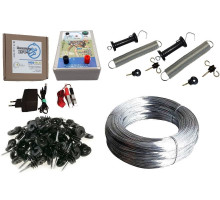
For most farmers, it is more cost-effective to buy a ready-made electric fence kit. The kit includes a pre-selected generator, conductor, insulators, posts, gate handles, earthing and basic accessories. This reduces the risk of one part being incompatible with another.
It is better to buy individual components if you already have a working electric fence and need to extend, reinforce or repair it. For example, to add another line for sheep, replace the conductor, fit a voltage tester, add a gate or install additional posts.
When is a ready-made kit preferable
- you are installing an electric fence for the first time;
- you need a system for a specific type of animal: cows, sheep, goats, pigs or horses;
- you don’t have time to select all the components yourself;
- you need a clear price for the kit;
- it’s important to get the fence up and running quickly on the pasture.
When is it better to assemble the components separately
- you already have an electric fence generator;
- you need to extend the perimeter;
- you need additional insulators, wires or gates;
- you need a customised layout for several types of animals;
- you want to reinforce an old electric fence.
Common mistakes when installing an electric fence
Even a good electric fence can perform poorly if it is installed incorrectly. Below are the mistakes most commonly made on farms.
- Poor earthing. A single short earth rod in dry soil often fails to ensure the system operates properly.
- A generator with no reserve capacity. It works on a clean, short line, but fails after rain, when grass grows, or when the perimeter is extended.
- Incorrect wire height. Animals walk under the wire or between the wires.
- The wire touches the grass. The voltage drops, the pulse weakens, and the battery discharges more quickly.
- Poor insulators. Some of the energy is lost into the posts, particularly on wooden or metal posts.
- No voltage tester. The farmer cannot see exactly where the voltage is dropping and why the animals are getting through the fence.
- Too few wires. For sheep, goats, pigs and wild animals, one wire is often not enough.
Which electric fence to choose for a specific task
For a pasture with cows
For cows, it is best to install two lines, a generator with a power reserve around the perimeter and a high-quality earth connection. If the pasture is near the farm, you can choose a 220 V model. If the area is remote, 12 V or a kit with a solar panel is preferable.
For sheep and goats
For sheep and goats, it is best to install 3–4 lines, use a clearly visible cord or wire, check the voltage regularly and do not skimp on the generator’s power. For sheep, a stronger pulse is important to penetrate the wool; for goats, the correct fence geometry is key.
For pigs
For pigs, the bottom wire is critically important. If it is too high, the pig will quickly learn to walk under the fence. It is best to use several wires and keep the area beneath the conductor clear so that the grass does not cause a current leak.
For horses
For horses, it is advisable to use a clearly visible tape or cord. The voltage can be moderate, but the installation must be safe: without sharp sags, dangerous knots or weak posts. A horse must be able to see the boundary, not just feel the electric shock.
For protection against wild animals
For fields, gardens, apiaries or farms where there is a risk of wild boars, foxes, deer or other wild animals entering, a reinforced electric fence is required. Choose a generator with a power reserve, 3–4 lines, sturdy posts, a good conductor and reliable earthing.
Commercial conclusion: when to buy an electric fence
It is worth buying an electric fence when you need to quickly organise grazing control, protect your land from animals escaping, reduce the cost of permanent fencing, or protect a field from wild animals. Compared to a permanent fence, an electric fence is more mobile, cheaper to install and more convenient for seasonal use.
But you need to save money the right way. The cheapest generator with no backup, weak insulators, thin wire and poor earthing often end up costing more, as the farmer wastes time on repairs, troubleshooting and rounding up the animals. It is better to choose a system suited to the actual conditions of the farm from the outset.
A simpler kit will suffice for a small pen. For sheep, goats, pigs, large pastures or protection against wild animals, a more powerful system is required. If in doubt, it is better to focus not on the minimum requirements, but on the power reserve in joules, the number of lines and the quality of the components.
FAQ: frequently asked questions about electric fences
Which electric fence should I choose for cows?
For cows, an electric fence of 2–5 J is usually suitable, depending on the length of the fence, ground conditions and the number of wires. For a short pasture, a lower power rating is sufficient; for a long perimeter, it is better to choose a generator with a margin.
How many joules are needed for sheep?
For sheep, it is advisable to use an electric fence with a power output of 4–6 J, and for long fences or challenging conditions, an even more powerful one. Due to their thick fleece, sheep are less sensitive to weak pulses, so a power reserve is very important.
What is the height of the electric fence wire for pigs?
For pigs, the bottom wire is set low, approximately 25–30 cm from the ground, to prevent the animal from passing under the fence. Often, 2–3 wires are used, as pigs actively test the lower part of the fence.
Which is better for an electric fence: 220 V or 12 V?
220 V is better for a permanent fence near a farm where there is mains electricity. 12 V is suitable for mobile grazing and remote areas. If there is no access to mains electricity, you should consider an electric fence with a solar panel.
Why is the electric fence not delivering a strong shock?
The most common causes are poor earthing, grass on the conductor, a weak generator, a damaged cable, faulty insulators or a perimeter that is too long. It is best to start by checking the voltage and the condition of the earthing with a tester.
Is an electric fence safe for animals?
Yes, modern electric fences deliver short pulses which cause an unpleasant sensation but are not designed to injure the animal. The main thing is to use a serviceable generator, follow the correct installation diagram and not connect the fence to dangerous power sources.
Conclusion
A properly configured electric fence is not just a pulse generator. It is a system in which the power output in joules, the height of the wire, the number of lines, the type of conductor, the quality of the insulators, the earthing and the actual conditions on the farm must all be correctly matched.
For cows and horses, a simpler setup is often sufficient. For sheep, goats and pigs, more careful attention must be paid to the height of the wires. For wild animals, a power reserve and a reinforced electric fence are essential. If the system is chosen correctly, it saves time, reduces the risk of animals escaping and helps organise grazing without the need for an expensive permanent fence.
Before purchasing, assess the type of animals, the perimeter length, ground conditions, the availability of an electricity supply and the seasonality of use. Then the electric fence will operate reliably, rather than simply ‘glowing like a light bulb’ near the farm.

0 reviews / Write a review