An oil extraction plant is a continuous production, where every extra tenth of a percent of oil in the meal or deviation in the miscel is directly converted into financial losses. It would seem that with such sensitivity to quality indicators, oil content control should be as operational as possible. However, most enterprises still work according to the scheme: they took a sample, sent it to the laboratory and received the result in 2–4 hours. During this time, the line has already processed 50–200 tons of raw materials. The question is not whether technological solutions for online control exist. They exist and have long been tested in the West. The question is why they have not become a standard and what really prevents their implementation.

NIR analyzers vs. laboratory - what is the fundamental difference?

Near-infrared spectroscopy (NIR) allows you to measure the oil, moisture, protein and fiber content in a material stream in real time - without sampling, without reagents, without the participation of a laboratory technician. The sensor is installed directly on the conveyor, in the auger or in the mixer pipeline, and generates data every 5–30 seconds.

A classic laboratory is a multi-stage process: sample collection, transportation, preparation, extraction using the Soxhlet method or similar, weighing, and recording the result in a journal. Even with ideal organization, it takes at least 1.5–2 hours from the moment of collection to the number in the journal. In practice, it takes 3–4 hours, taking into account the queue and staff workload.

The main difference is not in accuracy. Modern NIR systems provide an error of ±0.1–0.2% in oil content, which is quite comparable to the laboratory method with correct calibration. The main difference is in the time and number of measurements. The laboratory gives 6–12 data points per day. The NIR analyzer — thousands.

What does NIR measure in an oil extraction plant:

  • Residual oil in the meal after extraction is a key indicator of the efficiency of the process.
  • The moisture content of the meal at the outlet is critical for safe storage and high-quality pelleting.
  • The concentration of oil in the mist is the basis for controlling the operation of the distillation unit.
  • Oil content and moisture content of seeds at the input - input control for adjusting technological parameters.

The fundamental advantage of NIR is that it is not a replacement for the laboratory, but rather a complement to it. The laboratory remains the reference and is used for calibration and verification. However, operational process control is made possible by online data, not in its absence.

Data Delay = Lost Money

This is not a metaphor. This is arithmetic.
With a line capacity of 500 t/day and a laboratory cycle of 3 hours, the plant “blindly” processes about 62 tons of sunflower between two control points. If at this time the process “went” towards an increased residual oil content of the meal by 0.3% above the norm, this is a direct shortage of oil. At a price of $ 1,100 / t, losses for one such episode amount to $ 60–80. For a year, with several such deviations per week, the figure grows to $ 150,000–300,000.

Let's consider three specific scenarios.

Scenario 1. Increased residual oil in the meal. Violation of the extraction regime — solvent temperature or seed level in the extractor — leads to an increase in residual oil content from 0.7% to 1.1%. During laboratory control, the operator learns about this after 2–3 hours. All this time, the plant actually “sells” the oil together with the meal at the price of the meal.

Scenario 2. The oil content of the input raw material has changed. A new batch of seeds has arrived from another region — the oil content is lower by 2.5 pp. Without online input control, the oil yield is recalculated post facto. The planned change indicators have already been calculated “according to the old norm” — and the technologist does not know whether to look for a problem in the process or accept the fact of a change in the quality of the raw material.

Scenario 3. Meal moisture beyond the norm. Meal with a moisture content of more than 10–11% when packaged is a risk of spontaneous combustion and spoilage. If laboratory analysis shows an excess after the batch has been stored or loaded into wagons, there will be either a claim from the buyer or costs for re-drying and reloading.

What is common in all three scenarios is that the decision is made after the deviation, not during it. Online measurement takes the operator from “firefighter” mode to “pilot” mode — he sees the instruments and reacts to the disaster.

How to "live" without online data and how much it costs

Most domestic plants compensate for the lack of online control with a system of “protective buffers”: stricter internal standards for residual oil content, increased sampling frequency, additional staff in the laboratory, manual checks by the operator “by touch and color.” This system works — but it is expensive.

Direct costs to compensate for the lack of online control:

  • Intentionally understated standards — the plant undershoots oil output in order to have a "safety margin" without operational data.
  • Increased costs for reagents and equipment due to the increased number of laboratory tests.
  • The salary of night lab technicians means the process doesn't stop, which means the control doesn't stop either.
  • Costs for complaints and reprocessing of batches with deviations in meal moisture content.
  • Penalties for quality indicators when delivering for processing or export.

There are also indirect costs that are more difficult to calculate. The lack of operational data means making decisions based on the experience and intuition of the technologist, rather than on actual process indicators. This makes it impossible to automate accounting at oil extraction plants in the full sense: without a continuous flow of high-quality data, no MES system or accounting platform can build a reliable material balance in real time. As a result, the report on oil output is generated at the end of the shift or day - and is only a snapshot of the past, not a tool for managing the present.

It is worth mentioning the personnel risk separately. A plant that “lives” without online data critically depends on specific people — an experienced technologist, an attentive laboratory assistant, a responsible operator. As soon as this person goes on vacation, is fired or gets sick — the quality of control drops. The NIR system does not get sick or go on vacation.

Why online monitoring is still not the standard

There are several reasons, and none of them are technical.

First, the high initial cost. A full-fledged NIR system for an OEZ with several measurement points costs 80,000–200,000 EUR, depending on the configuration and manufacturer. For a company with an old investment culture, where it is customary to “repair, not replace”, this is a psychologically difficult threshold.

Secondly, the difficulty of justifying ROI within the company. Losses from data delay are distributed over time, invisible at the level of a single shift, and not reflected as a separate line in the P&L. The director sees the costs of the NIR system — and does not see the “line” of money saved, because it is “dissolved” in overall efficiency.

Third, distrust of new measurement methods. "We've been testing oil content using the Soxhlet method for 30 years - why do we need a spectrometer?" is a real position that can be heard at production meetings. Overcoming this barrier requires not only a technical but also a managerial solution.

Fourth, there is no market pressure. As long as competitors operate in the same way, there is no competitive incentive to invest in more precise control. The situation changes when entering more demanding markets or when players appear who have already invested in online analytics and have a lower cost of product.
Related news
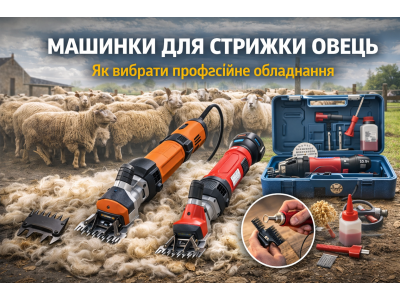
Sheep shears - buy professional shears
Sheep shearing machines: how to choose reliable equipment for your farm Sheep shearing is not just a seasonal procedu..
Featured
BEST SELLER
Propane bird and animal repeller mechanical KBS-M1
FTH-061
Country of origin: Türkiye Manufacturer: kurtbomsan Operating principle: Propane
5 reviews
8,000 грн.
BEST SELLER
Sahbaz butter churn 7l with timer – buy in Ukraine
FTH-278
Country of origin: Türkiye Manufacturer: Sahbaz Capacity, l: 7
3 reviews
7,500 грн.
BEST SELLER
Self-tapping insulator for electric shepherd
FTH-103
Country of origin: Poland Manufacturer: Horizon
3 reviews
7 грн.
The Sapsan-3 bird repeller for the golden bee-eater
FTH-308
Country of origin: Ukraine Square: 0.5 ha Operating principle: Acoustics
4 reviews
2,850 грн.
BEST SELLER
Electric Fence EPU-1 (Poland)
FTH-006
Country of origin: Poland Manufacturer: EPU Impact force, J: 0.7 Voltage, V: 220/12
2 reviews
2,100 грн.
ArticlesAll news
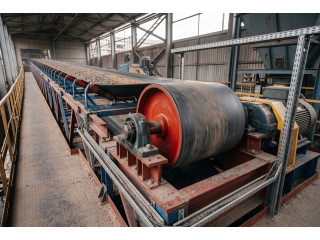
Belt conveyor drive drums: design, reliability and line operation optimization
Belt conveyors are the basic equipment for continuous movement of bulk, lumpy and piece materials in..
Watering livestock in winter: water standards, heating and containers on the farm
A cow that drinks ice water in winter is not getting enough feed. The energy to warm up what it drin..
The best fertilizers for winter crops: top solutions for autumn application
Autumn sowing of winter wheat, barley and rapeseed requires farmers to take a balanced approach to s..
Spare parts for MTZ and YuMZ tractors, features of technical maintenance of agricultural machinery
Features of technical maintenance of agricultural machinery: spare parts for MTZ, UMZ tractors, disk..
Choose effective fertilizers for your farm
Yellowing of the edges of the leaves, slowed growth or uneven ripening of the ear often indicate not..
Apiary as an additional direction of farming: what to consider before installing beehives
A free plot near a garden or field does not mean that it is enough to simply place a few hives there..
Increased load in the summer heat: when it becomes necessary to buy a radiator for a walk-behind tractor
During tillage, agricultural machinery operates under significant load, and in hot weather, the requ..
Industrial emissions control: why does an enterprise need regular laboratory measurements?
Industrial emissions are formed during fuel combustion, drying, painting, raw material processing, o..
Featured
Bioacoustic bird repellers - working principle and effectiveness
16/02/2026 1414
Bioacoustic bird repellers - working principle and effectiveness
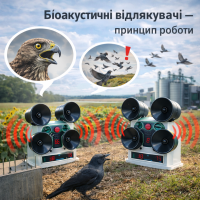
Bioacoustic bird repellers - working principle and effectiveness Bioacoustic bird repellers are professional protection systems that reproduce natural danger signals: the cries of birds of prey and th.. →
Bird repellers for the garden and berry orchards - crop protection
16/02/2026 891
Bird repellers for the garden and berry orchards - crop protection
Bird repellers for the garden and berry orchards - how to protect cherries, grapes and berries Orchards and berry orchards are particularly attractive to birds during the fruit ripening period. Starli.. →
Milking machine: oil or dry?
19/11/2020 4352
Milking machine: oil or dry?
Milking machine: oil or dry?Which milking machine is better: oil or dry, you will find out by reading this articleFeatures of the design of oil pumps:Oil (full-fledged), or closed design pumps:Origina.. →
Electric cowherd
17/02/2026 989
Electric cowherd
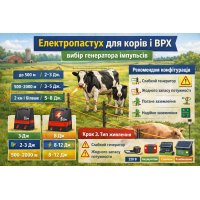
Electric shepherd for cows and cattle - how to choose a pulse generator The electric cow fence is used to control cattle in pastures, walking areas and farms. The electric fence forms a persistent ref.. →
Pulse generator for electric shepherd - how to choose
17/02/2026 922
Pulse generator for electric shepherd - how to choose
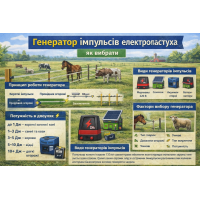
Pulse generator for electric shepherd - operating principle and selection The pulse generator is the main element of the electric shepherd, which creates short electrical pulses and feeds them into th.. →
Wire, cord and tape electric shepherd
17/02/2026 1062
Wire, cord and tape electric shepherd
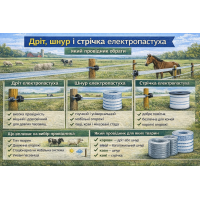
Wire, cord and tape for electric shepherds - which conductor to choose The conductor is the conductive line of the electric fence, along which the pulse from the generator passes along the entire fenc.. →
Sheep Shearing. When and How to Shear Sheep
19/11/2020 14470
Sheep Shearing. When and How to Shear Sheep
Sheep shearing. When and how to shear sheepShearing is a very important production process in breeding and keeping sheep of all productivity areas. Timely and correct shearing of sheep is an important.. →
Last Articles
Comparison of effective pigeon repellants: which one to choose for your site?
22/07/2026 411
Comparison of effective pigeon repellants: which one to choose for your site?
Effective pigeon repellers: overview and selection for your site Pigeons, despite their peaceful nature, can be a real problem for farmers, homeowners, and city dwellers. They not only pollute the ter.. →
How to install an electric fence with your own hands: step-by-step instructions
22/07/2026 358
How to install an electric fence with your own hands: step-by-step instructions
Self-installation of an electric fence: step-by-step instructions Organizing effective livestock management or protecting an area from wild animals often requires reliable solutions. One of the most p.. →
How to get rid of pigeons: mistakes and effective methods of scaring them away
22/07/2026 376
How to get rid of pigeons: mistakes and effective methods of scaring them away
Effective protection against pigeons: common mistakes and ways to avoid them Pigeons, although they are common inhabitants of urban landscapes, can cause significant damage to private households, indu.. →
How to Choose a Bird Scarer: A Complete Guide for Gardening and Farming
22/07/2026 336
How to Choose a Bird Scarer: A Complete Guide for Gardening and Farming
Introduction: Why do we need effective bird repellers? The damage caused by birds can be significant: from destroying crops in fields and gardens to polluting warehouses and livestock farms. Small bir.. →
Plastic drinking troughs for sheep and goats: selection and care
21/07/2026 390
Plastic drinking troughs for sheep and goats: selection and care
Why do sheep and goats need constant access to water? Sheep and goats must have constant access to fresh, clean drinking water. Restricting water can reduce feed intake, productivity, and the general .. →
Electronic propane bird repellents: how they work, setup and maintenance
21/07/2026 372
Electronic propane bird repellents: how they work, setup and maintenance
Effective crop protection: electronic propane bird repellers Preservation of crops and protection of livestock complexes from bird invasions is one of the key tasks for any farmer. Among the various m.. →
How to choose an electric fence to protect against wild animals: selection criteria and what’s included
21/07/2026 347
How to choose an electric fence to protect against wild animals: selection criteria and what’s included
Why do you need an electric shepherd against wild animals? An electric fence for wild animals is used as a perimeter fence to deter animals from entering a pasture, enclosure, garden, field, or other .. →
DIY Electric Fence Installation: How to Properly Install Nail-On and Screw-In Electric Fence Insulators
21/07/2026 362
DIY Electric Fence Installation: How to Properly Install Nail-On and Screw-In Electric Fence Insulators
The Role of Insulators in an Electric Fence SystemAn electric fence is an effective and economical solution for grazing livestock and protecting an area from wild animals. However, the reliability of .. →
Care and maintenance rules for professional sheep shearing machines: blade replacement and preventive maintenance
21/07/2026 389
Care and maintenance rules for professional sheep shearing machines: blade replacement and preventive maintenance
Introduction: Why proper care of shearing equipment is criticalEffective farm management and livestock care require the use of reliable equipment. Modern sheep shearing machines are designed to withst.. →
Milking Machines for Goats and Sheep: Differences from Cow Systems and Selection Rules
21/07/2026 408
Milking Machines for Goats and Sheep: Differences from Cow Systems and Selection Rules
Why can't goats and sheep be milked with a cow milking machine?Machine milking of small ruminants has fundamental differences from the handling of cattle. The main reason lies in the animals' physiolo.. →
Electric Butter Churns: Assessing Payback and Productivity
21/07/2026 364
Electric Butter Churns: Assessing Payback and Productivity
Electric Butter Churns: How to Assess Whether a Purchase Is WorthwhileProducing your own butter is a logical step for any farm with access to whole cow's or goat's milk. Selling raw milk often brings .. →
How to Choose and Buy an Electric Fence for Cows: A Complete Guide to Selecting a Kit
21/07/2026 341
How to Choose and Buy an Electric Fence for Cows: A Complete Guide to Selecting a Kit
Why Cattle Need a Specialised Electric FenceOrganising grazing for cattle requires reliable control of the territory. Traditional wooden or metal fences require significant financial expenditure and i.. →
How to Choose and Which Electric Cattle Prod to Buy: Comparison of Models and Selection Criteria
21/07/2026 365
How to Choose and Which Electric Cattle Prod to Buy: Comparison of Models and Selection Criteria
Introduction: the role of electric livestock prods in modern animal husbandryManaging a large herd on livestock farms requires considerable effort and patience from staff, as well as strict compliance.. →
Dark theme